A feast of pure grace: why the Immaculate Conception still speaks to the heart
She who became the Mother of the Son of God was free from all sin that could separate Her from God.
When Cyprian Kamil Norwid wrote his Litany in 1852, he slipped into its prayerful poetry an appeal to the “Immaculate One”. In doing so, he was giving voice to a belief that had lived for centuries in Christian prayer and reflection: the woman chosen to be the Mother of the Son of God, who held him in Bethlehem and received his broken body at Calvary, was preserved from any sin that would break her communion with God. Wrapped in the love of the Most Holy Trinity, Mary answered that love with a human heart untouched by sin.
The Church’s faith in this mystery deepened over the centuries, sometimes through lively theological debate. Pope Sixtus IV placed the feast of the Immaculate Conception on the Roman calendar in 1477 and encouraged its celebration; by the time of Saint Pius V in the 16th century, it was widely kept throughout the Church. The truth reached its definitive form on 8 December 1854, when Blessed Pius IX proclaimed the dogma of the Immaculate Conception in St Peter’s Basilica before 54 cardinals and 140 archbishops and bishops. In Ineffabilis Deus, he declared that Mary, “far more than any of the angelic spirits”, had been so richly filled with divine gifts that she was “free from any stain of sin… all beautiful and perfect”.
“All beautiful”: a name of hope
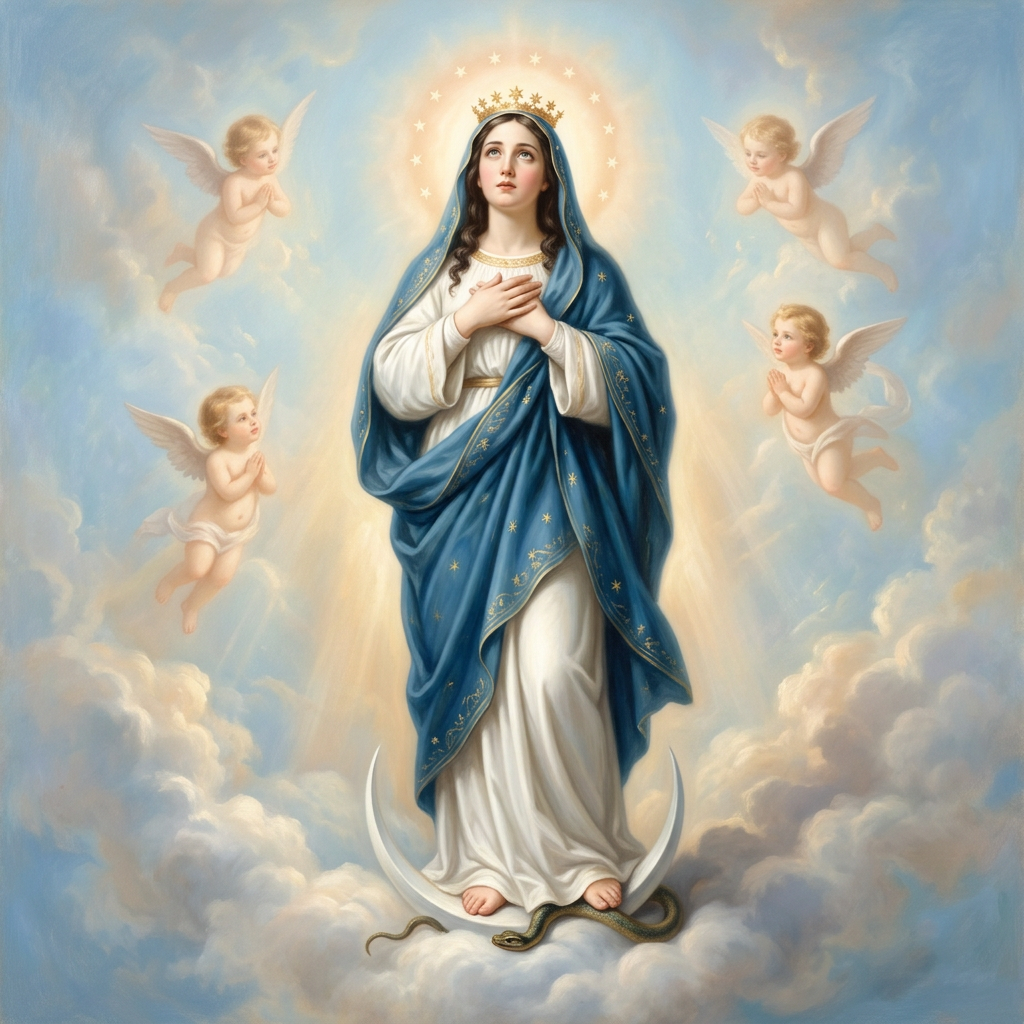
The Church has long called Mary Tota pulchra — all beautiful. At the Annunciation, the angel greets her as “full of grace” (kecharitomene), a title Pope Benedict XVI described as Mary’s “most beautiful name”, given by God himself to show that she is forever loved, chosen, and destined to welcome Jesus, “the incarnate love of God”.
This beauty isn’t about outward appearance. It’s spiritual: the splendour of a soul completely open to grace. And importantly, it doesn’t place Mary far away from us. Quite the opposite — it brings her near. If sin is really all the self-centredness that shrinks the heart and breaks communion, then Mary’s freedom from sin means her heart was widened by God to his own measure, so that she could be close to everyone in love.
At the source: Christ’s saving Blood
The Solemnity of the Immaculate Conception points straight to Christ. The Collect for the day says it clearly: “O God, who by the Immaculate Conception of the Blessed Virgin prepared a worthy dwelling for your Son, and, by the foreseen merits of Christ’s death, preserved her from all stain…” In other words, Mary is praeredempta — pre-redeemed — by the merits of her Son’s Passion. The grace that kept her from sin is the same saving love poured out on the Cross, given to her in advance from the first moment of her life.
That’s why this feast is, at heart, a celebration of the precious Blood of Christ. His love “without measure” not only kept Mary unstained; it also restores in every baptised person the beauty and dignity wounded by sin. In Mary, we catch a glimpse of what grace wants for all of us: to be “holy and blameless before him” (Eph 1:4).
White roses in Rome
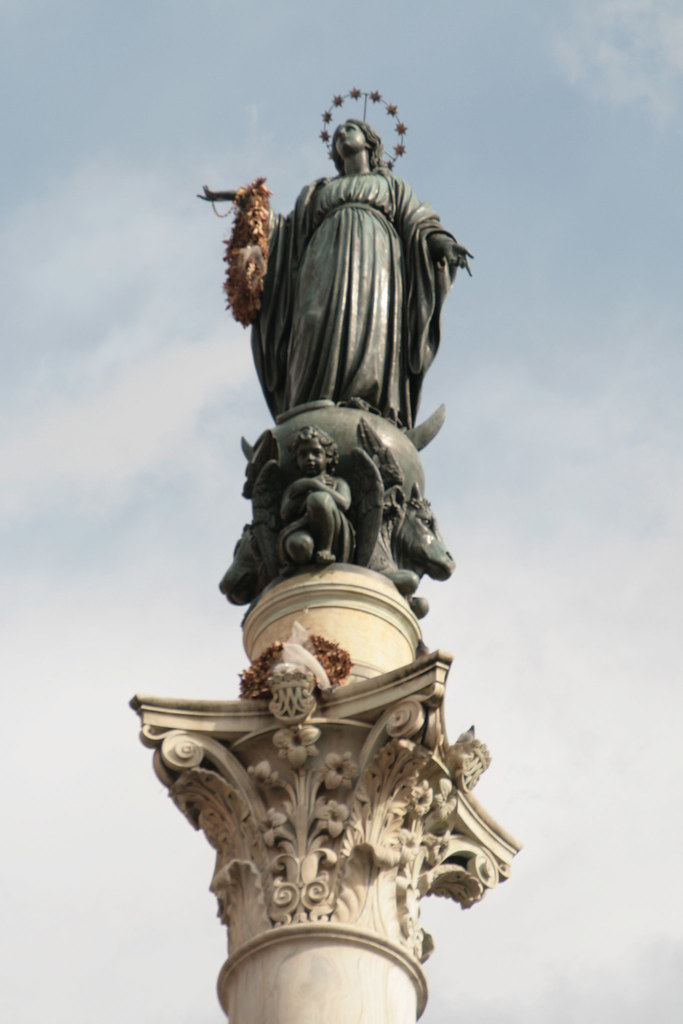
Rome marks the day with a tradition that is simple but deeply moving. In Piazza Mignanelli, beside the Spanish Steps, stands the Column of the Immaculate Conception, dedicated by Pius IX on 8 December 1857. Each year, firefighters are first to honour Our Lady in the morning, lifting a wreath of white flowers to the statue high above the square. Later, the Pope comes to pray, bless the city, and place white roses at Mary’s feet — a custom made a regular act of devotion by Pius XII in 1953 and carried on faithfully by his successors.
In 1998, at the foot of that column, Saint John Paul II reminded Romans and pilgrims alike: “O Mary! In the East and in the West, from the very beginning, the People of God confess with faith that you are the most pure, most holy, incomparable Mother of God… Every year, on the day of your feast, the Church of Rome and the entire city, together with their bishop, come here… to pay homage to you, who are a sign of unfailing hope for all people.” He echoed Saint Paul’s blessing: we were chosen in Christ “before the foundation of the world” to be holy in love.
An invitation to begin again
The Immaculate Conception is both a promise and a path. It tells us that God’s original design for humanity is not some lost dream, but a real grace at work now and a hope for what is still to come. In Mary, the Church sees her most radiant member and her surest sign of hope. In Christ, whose love preserved her and redeems us, we can begin again — freed to love, strengthened to serve, and called to the beauty for which we were made.
The Immaculata
Among the wreaths and white flowers laid at the Column of the Immaculate Conception near the Spanish Steps, it’s not unusual to see tributes carrying the image of Saint Maximilian Maria Kolbe. This Franciscan, who gave his whole life to the Immaculate, celebrated his first Holy Mass on 29 April 1918 in the chapel of Our Lady of the Immaculate Conception at Sant’Andrea delle Fratte, just off Piazza di Spagna. Even now, in the quiet lanes around that church, you can almost hear the echo of his burning prayer:
“Permit me to praise you, O Most Holy Virgin; allow me to live, work, suffer, be consumed and die for you, and to bring the whole world to you.”
His devotion was fully Trinitarian too: he adored the Father for placing the Son in Mary’s most pure womb; he adored the Son who chose to become truly her child; and he adored the Holy Spirit who formed the flesh of the Incarnate Word within her immaculate womb.
Kolbe’s prayer was answered in a life that ended in the gift of himself for another. In the darkness of Auschwitz, love broke through in a place built to deny both God and human dignity. At Kolbe’s canonisation, Saint John Paul II highlighted the heart of that witness: “Maximilian did not ‘die’ — but ‘gave his life… for a brother’.” In that terrible death was the full greatness of human freedom and human love: he gave himself to death out of love. And in his death, there was a clear witness to Christ. Kolbe showed that where hatred tries to rule, charity can still take root — and even triumph.
Admirable Mother
From Sant’Andrea delle Fratte, a short climb up the Spanish Steps brings you to Trinità dei Monti and another beloved Marian place. In a monastery corridor there hangs an 1844 fresco of the Blessed Virgin Mary, now known as Mater Admirabilis — Admirable Mother. When Pope Pius IX visited the monastery on 20 October 1846, he paused before the image and gave it that title, moved by Mary’s calm, youthful beauty and the purity it expresses. The fresco recalls the Church’s confession that she is “all beautiful”, radiant with innocence and holiness by grace.
It also became a place of prayer for Romantic poets; it is said that Cyprian Norwid composed the verses of his Litany here. Mater Admirabilis speaks not only of Mary’s unique grace, but also of the high calling given to every person: a call to holiness and beauty that, even in suffering and uncertainty, still reflects the invitation to share in infinite love.
That love, shown most fully on the Cross, is without measure. In the heart of Rome, these two Marian places — Sant’Andrea delle Fratte and Trinità dei Monti — remind us that grace still lives in the stones and streets of the city, and that the Immaculate still draws hearts to Christ with a mother’s gentle tenderness and hope.