There are certainly good reasons to believe in God. But there are also reasons, many would say, to doubt Him, or even reject Him altogether. Wouldn’t life be simpler if God’s existence were obvious?
Saint John Paul II answered that God is the One who is — the absolute, uncreated Mystery. If God were not mystery, there would be no need for revelation. In other words, there would be no need for God to reveal Himself at all.
The Pope argued that such questions only make sense if human beings, with their limited minds and subjective understanding, could somehow cross the vast gap between creation and Creator, between what is not necessary and the One who is necessary.
He said these are not only Messori’s questions, but the questions of our time. They come from people struggling along difficult and often confusing paths in search of God. Why is there not more concrete proof? Why does God seem hidden? Shouldn’t His existence be obvious?
These are the questions of modern agnosticism. And agnosticism, John Paul II noted, is not the same as atheism. It is not the fully organised denial found in Marxist atheism or in the atheism of the Enlightenment. It is more uncertain, more restless, more hesitant.
For John Paul II, God’s self-revelation reached its highest point in the Incarnation — in God becoming man. Here, he said, lies the great challenge to every attempt to reduce the divine to the merely human. Inspired by thinkers such as Feuerbach, modern atheism tried to explain God away. But the Christian claim is far more radical: God truly became man in His Son, born of the Virgin Mary.
And it was not only in the Nativity. It was also through the Passion, the Cross, and the Resurrection that God made Himself known most fully in human history — the invisible God revealed in the visible humanity of Christ.
Even on the eve of the Passion, the apostles asked Jesus, “Show us the Father.” His reply remains central to Christian faith: “How can you say, ‘Show us the Father’? Do you not believe that I am in the Father and the Father is in me? … The Father and I are one.”
These words, John Paul II suggested, bring humanity as close as it can come to God in this life. And yet they do not give the final vision — the direct seeing of God “face to face” that belongs to eternity.
So, the question remains: could God have come any closer? Could He have lowered Himself further to make Himself known?
John Paul II’s answer was striking: no, He could not. In a sense, God has already gone as far as He possibly could. Indeed, He went too far for some. Christ became, as Saint Paul wrote, “a stumbling block to Jews and foolishness to Gentiles.”
Why? Because Jesus did something shocking: He called God His Father and revealed Him so openly that many could not bear such nearness. The protest began.
John Paul II linked that protest with two major traditions of rejection: first the Synagogue, then Islam. Both, he suggested, found it impossible to accept a God so close, so human, so willing to enter suffering and death. For them, God must remain utterly transcendent — majestic, merciful, yes, but not so near that He would share in the pain of His creatures.
And yet, from the Christian point of view, God revealed far more than people expected. He revealed Himself in His Mystery. The problem is that human beings often cannot endure that closeness. We say we want God to come near, but when He does, we are unsettled by the scale of His self-giving.
Yes, humanity already knows that in God “we live and move and have our being”. But why must that truth be sealed by the Cross and confirmed by the Resurrection?
The Christian answer is uncompromising: “If Christ has not been raised, then empty is our preaching; empty, too, your faith.”
That is the heart of the matter. God has not remained distant. According to the Christian faith, He has drawn so near that He became one of us. The real question is not whether God has hidden Himself, but whether we are ready to face the extraordinary way in which He has chosen to reveal Himself.
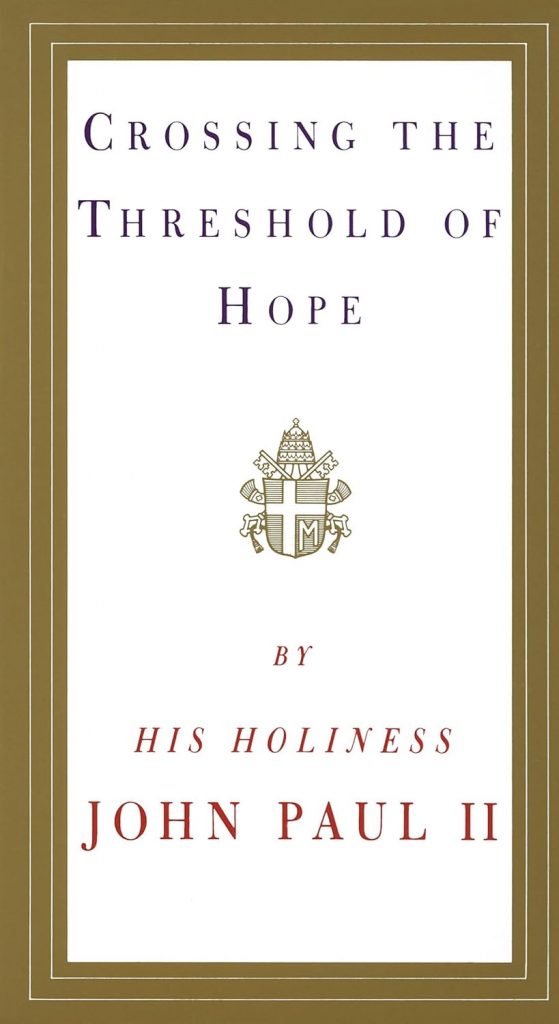
Saint John Paul II, “Crossing the Threshold of Hope”, pp. 47-49