By John Gaspars
A woman who was found with a Bible was publicly shot. An elderly priest was kidnapped and never heard from again. Three buses full of students and teachers from a Christian school hit a land mine. . . These are just a few of the huge number of examples of extremely brutal and unrestrained contemporary attacks on Christians.
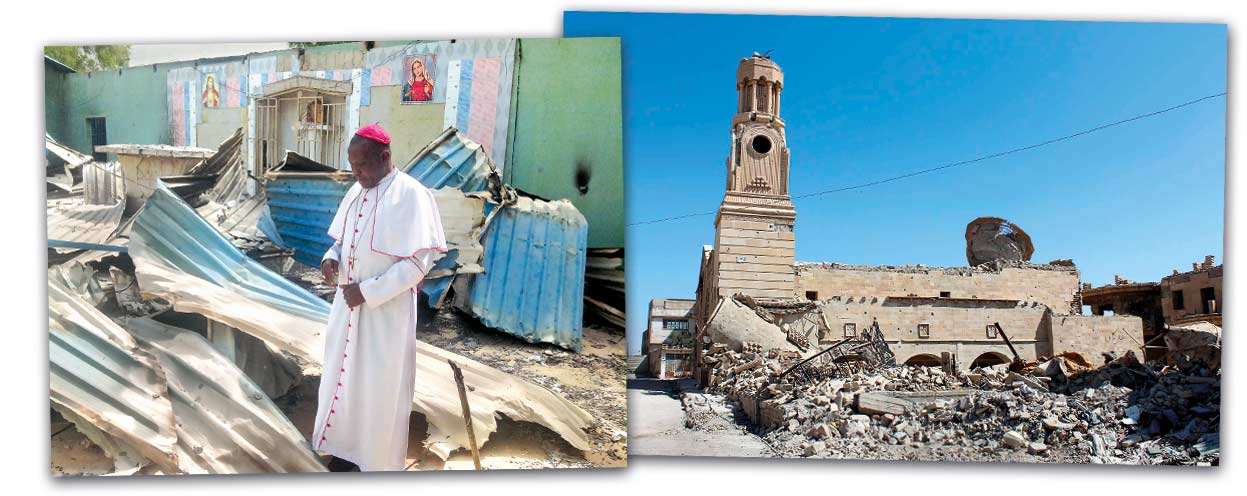
A shocking picture of modern persecution
“The current situation of persecuted Christians and other minorities is catastrophic and disturbing,” says Markus Rode, director of the German agency of the international organization ‘Open Doors’.
“Freedom of religion is massively suppressed. If millions of affected people do not have the opportunity to draw attention to their situation, then politicians and we as Christians must do much more than we have done so far. Persecuted Christians ask for our prayers so that they can be strengthened in their faith.
The top ten countries where Christians are most persecuted include: North Korea, Afghanistan, Somalia, Libya, Pakistan, Sudan, Eritrea, Yemen, Iran and India […].
The organization mentions China as a shameful example of the deterioration of living conditions for Christians. This country […] is a perfect example of the increasing restriction of religious freedom by an increasingly repressive regime. Last year, more Christians were imprisoned there than in any other country.
‘Open Doors’ also points to the growing persecution by Islamic extremism, especially in Asia and Sub-Saharan Africa, e.g., in Libya and Egypt.
In Nigeria, 3,731 Christians were murdered for their faith, more than in all other countries combined” (also see https://christianpersecution.com).
In Nigeria itself, many villages were burned, a number of churches were destroyed, and a lot of damage was done. High-profile murders that occurred during Christmas 2015 are remembered.
Christians living in India are in an equally difficult situation. Being a disciple of Christ in this country means exposing oneself to daily persecution both at home, on the street and in the workplace. Christians are also murdered there.
In February 2019, Anant Rama Gand was murdered in the state of Orissa, eastern India. He was 40 years old and the father of five children.
“He converted to Christianity a year ago. He received the sacrament of baptism two months ago. His conversion caused great outrage in the village, inhabited mostly by radical Hindus.
Both he and his family were discriminated against, they were not allowed to take water from the common well, and they were thrown out of the village. On the day of the murder, Anant was alone at home with his six-year-old son, from where his executioners kidnapped him. His body, with his head cut off, was found on the road outside the village” (Markus Rode).
Iraqi Christians pray in their homes, not knowing whether their children will return safely from school. Patriarch of the Chaldean Church, Cardinal Louis Raphaël I Sako gave the example of a family from Baghdad from which a little girl was kidnapped. After some time, the parents received a phone call from the kidnappers, who confirmed that they were holding their daughter. The mother cursed them by all that is sacred and asked them to give her the child back. She promised to collect any amount needed for the ransom.
However, she heard on the phone: “We don’t want your money. We want your heart to break.” After a few days, a raped, bloody and profaned body of a child was found in the street (W. Cislo, Immigrants at the gates. Refugee crisis and Christian martyrdom of the 21st century).
“One of the bishops from Homs [Syria] said that a bomb was planted under his episcopal throne. The bombers said it would have a better effect if he was blown up this way. Islamists deliberately shot at icons, smashed holy figures, and destroyed churches, sometimes recently renovated. All this just to humiliate Christians” (ibid.).
There are also numerous murders of clergy. Priests or fathers who have served in this land for decades are murdered or kidnapped.
“However, it should be noted that in Syria most of the clergy and nuns remained with the faithful. It is also interesting that when the priest or sisters stay in place, the faithful also stay” (ibid.).
Fear, a constant sense of threat and uncertainty of tomorrow are everyday life for Christian inhabitants of parts of Africa and the Middle East.
“Another problem is the kidnapping of young Coptic women and forcibly marrying them off to Muslims. To dissuade them from running away, humiliating photos are often taken of them and then threatened that if any of them want to return home, these photos will be made public.
These are human tragedies. These women are enslaved, they are imprisoned, they are afraid to return home, and even if they did, their family may not accept them because they think that such a girl is already disgraced. So, she must live with the one she was married to – without her consent, without any questions” (ibid.).
Very often, Christian women are treated as spoils of war. Islamic terrorists thus allow rape, sexual slavery and trafficking in women.
A few years ago, terrorists from the notorious Islamic militant group Boko Haram kidnapped 350 Nigerian girls to forcibly marry them off to Muslims. This dangerous organization treats women as “commodities” that can be sold at the market. The practice of women’s slave markets was until recently used by the Islamic State in Iraq and Syria. Prices for the “merchandise” ranged from $150 to $500.
“Father, forgive them, for they know not what they do” (Luke 23:34)
In this vast amount of cruelty towards Christians, however, there are numerous examples of the heroic faith of Christ’s followers and their loving attitude not only towards their suffering brethren, but also towards their persecutors.
On February 15, 2015, on the beach in Tripoli (Libya), jihadists from the Islamic State brutally beheaded 21 Copts, i.e., Egyptian Christians. Their deaths became famous because their executioners recorded the execution.
The film, which circulated around the world, became a great testimony to the faith of the martyrs. Brought to their knees by their executioners, the martyrs knelt down and the murderers cut their throats and cut off their heads. However, there was an extraordinary peace in the faces and behaviour of the martyrs. In the video they can be heard loudly shouting: “My Lord, Jesus Christ!”
At the moment of death, the martyrs asked God to strengthen them in their faith and to forgive their murderers! The murdered Copts were young men – husbands and fathers. To support their families despite the danger, they went to work in Libya. They had a lot to lose. They could have denied their faith, and they would have lived. But they chose Christ!
A few years ago, the Christian inhabitants of the capital of Jordan – Amman, also gave an extraordinary testimony of unwavering faith. They were wealthy, had good jobs, expensive houses and cars. When the Islamists gave them an ultimatum: “Either convert to Islam or you will be exiled” – then, without hesitation, they decided to leave everything and leave the city, just not to deny their faith in Christ!
Brotherly love even to martyrdom
On April 30, 1997, 36 Catholic seminarians and eight of their guardians were killed in a minor seminary in the city of Buta (Burundi). The young men were between 15 and 20 years old. Their killers were rebels from the Hutu tribe, belonging to the so-called National Council for the Defence of Democracy.
The rebels broke into the seminary building and dragged the boys straight from their beds. Armed with knives, rifles, pistols and grenades, the attackers ordered them to divide into two groups – Tutsis and Hutus. All Tutsi boys were to be killed. However, the seminarians refused to divide. As a result, everyone died – both Tutsis and Hutus. . . Created on the basis of Holy Baptism, brotherhood turned out to be more important than ethnic origin.
Just before this massacre, seminarians participated in an Easter retreat. The rector of the local sanctuary – Fr. Nicolas Niyun-geko wrote this about his pupils: “At the end of the retreat, the students were animated by a new kind of inspiration that seemed to prepare these innocents for holy death. They were very joyful and kept repeating: ‘God is good and we have met Him.’ They spoke of heaven as if they had just returned, and of the priesthood as if they had just been ordained. […]
It was obvious that they had had a very strong experience that changed their hearts, although they did not fully realise what it was. From that day on, they prayed and sang in the church and danced on the way to it. They were happy to discover the treasure of heaven. The murderers who surprised them in their beds ordered the young men to divide into two groups […]. One of the groups was to be killed, but the seminarians preferred to die all together.
When the evil plan failed, the killers attacked the boys to murder them with rifles and grenades. At this point, some of the seminarians could be heard singing psalms of praise to God, while others were saying: ‘Forgive them, Lord, for they know not what they do’ [cf. Luke 23:34]. Still others, instead of fighting or fleeing, comforted their brothers, knowing full well what fate awaited them.
Their death was like a soft and luminous path that led straight […] to a place where there is no pain, noise and fear. They died like martyrs of brotherhood […].
Forty days after the massacre, the seminary dedicated its small church to Mary Queen of Peace. From then on […] it became a place of pilgrimage. Burundians come there to pray for the reconciliation of peoples, peace, conversion and hope for all.
Let this testimony of faith, unity and brotherhood be a message to humanity. Let the blood of the martyrs be a seed of peace in our country and around the world” (quoted in: J. L. Allen Jr., Global War on Christians. A shocking picture of contemporary persecution, p. 262).
One of the seminarians who survived this pogrom says this about the executioners: “I pray that the sacrifice of the murdered students and our suffering will lead these soldiers, the perpetrators of suffering, to their conversion” (quoted in: ibid., pp. 262-263).
Martyrdom of the spirit
In view of the enormous persecution of our brothers and sisters in faith, it is worth realising how great a grace we have in being able to profess our faith in peace and relative safety in our country. It is worth realizing what a great gift it is to be able to participate in the Eucharist and sacramental life every day. Let’s give thanks for priests who can perform their ministry without major restrictions and be ministers of the sacraments instituted by Christ.
However, it is worth realising that the public profession of faith, even in our country, is gradually becoming more and more stigmatised and criticised. Persecution for faith does not have to take the form of direct physical extermination. It may be the silent and hidden suffering of a person who, due to his or her Catholic faith, values and worldview, experiences various unpleasant situations at work, in their environment or even among their loved ones.
The Lord Jesus said: “Blessed are you when men revile you and persecute you and utter all kinds of evil against you falsely on my account. Rejoice and be glad, for your reward is great in heaven, for so men persecuted the prophets who were before you” (Mt 5:11,12).
God requires us to clearly define whether we want to belong to His kingdom of love, goodness, truth, honesty, purity or to the kingdom of selfishness, indifference, evil, lies, dishonesty and impurity.
“I know your works: you are neither cold nor hot. Would that you were cold or hot! So, because you are lukewarm, and neither cold nor hot, I will spew you out of my mouth” (Rev 3:15-16).
This “lukewarmness”, indifference or contempt for God’s graces, spiritual coldness and neglect of prayer should have no place in our lives. Let’s remember that we are also called to give heroic witness to our faith. Let the area of our “martyrdom” be daily systematic prayer and faithful adherence to Christ and God’s commandments!
?
03/03/2024