 “The Eucharist itself is the greatest miracle,” Saint Thomas Aquinas. But this greatest of miracles hides a mystery that completely escapes our senses: sight, taste, touch . . .
Despite the explanations of the wisest theologians, the presence of God in the Eucharist remains for us a mystery of faith that surpasses the natural possibilities of reason. God so great and bread so small and fragile! The creator of everything hidden under the veil of a little piece of creation! How to understand this one-of-a-kind miracle that takes place at the moment of the consecration of the bread and wine?
One of the French bishops, preaching at the World Youth Day in Paris (1997), said: “I read the Holy Scriptures in the usual way. After all, we all have the right to simply read the Bible. And so, I read the following words: ‘This is My Body’. I read and I believe. The doctrine of the Eucharistic presence of Christ could fill many books, but everything is contained in this one sentence: ‘This is My Body’. This sentence can only be accompanied by one confession: ‘I believe!’. That should be enough. Jesus is here, truly present on the altar. He is with us every day in His Eucharist”.
Sometimes, however, our faith in the real presence of Christ in the Eucharist experiences various crises. In His compassion for our weakness, God gives us His signs in the form of Eucharistic miracles. Not to replace faith with the certainty of experience, but to inspire it to greater activity.
Various Eucharistic miracles are already known to the Church of the first centuries. With Saint Cyprian of Carthage (†258) we find a story about a woman who sacrificed to pagan idols. When she returned to her home and opened the vessel in which she had kept the Eucharist, fire came out of it.
From later times comes the story of the life of the first Patriarch of Venice, who was St. Lorenzo Giustiniani. While he was celebrating Midnight Mass at the Cathedral of St. Peter in the Castello, immediately after the consecration he saw the Child Jesus in the Host. Let’s add that Blessed Angela of Foligno and Saint Faustina had similar experiences.
A very spectacular miracle took place during the pontificate of Gregory the Great. As the Pope was distributing Holy Communion, a woman approached and laughed out loud. The Pope refused to give her Holy Communion and, after the end of the liturgy, demanded a public explanation of the reason for such behaviour. The woman said, “I laughed when I heard it was the Body of Christ. After all, I made this bread with my own hands!” Pope Gregory knelt down and asked everyone present to pray for faith for the woman. Unexpectedly, the Host, which was resting on the altar, turned into an authentic body. Upon seeing it, the woman experienced a sudden conversion.
The miracle in Lanciano, Italy, is certainly one of the most famous. An anonymous 8th-century monk, while celebrating Mass, began to doubt the real presence of Christ in the consecrated bread and wine. Suddenly he saw the host changing into flesh and the wine into blood. The Holy Blood, which in its clotted form forms five irregular nuggets, is kept and worshiped in the temple to this day. For twelve centuries it has not been subject to even the slightest corruption.
This unique relic, shocking to human logic, has often become the object of analysis by scholars. Research in the early 1970s produced the following results: the Flesh and Blood are truly human flesh and blood. They come from the same person with blood type AB (the blood on the Shroud of Turin is of the same type). The proteins in the blood are distributed in a normal manner and in a ratio identical to that found in any healthy human blood.
The nature of the miracle at Lanciano allows it to be linked to the miracle at Regensburg. On the spot where once a priest, rushing to visit a sick person, overturned the vessel with the Blessed Sacrament, pious believers erected a church.
Another priest, who celebrated Mass in this church in 1250, doubted the presence of Christ in the Eucharistic forms. “Is it possible that the words spoken by man change wine into the Blood of the Lord?” – He was asking. Paralysed by doubt and fear, he hesitated to lift his chalice. Suddenly, from the great crucifix above the tabernacle, Christ stretched out His hand towards the priest, took the chalice from him and lifted it up. The faithful fell to their knees, and with them the priest, who with tears adored the Blood of the Lord.
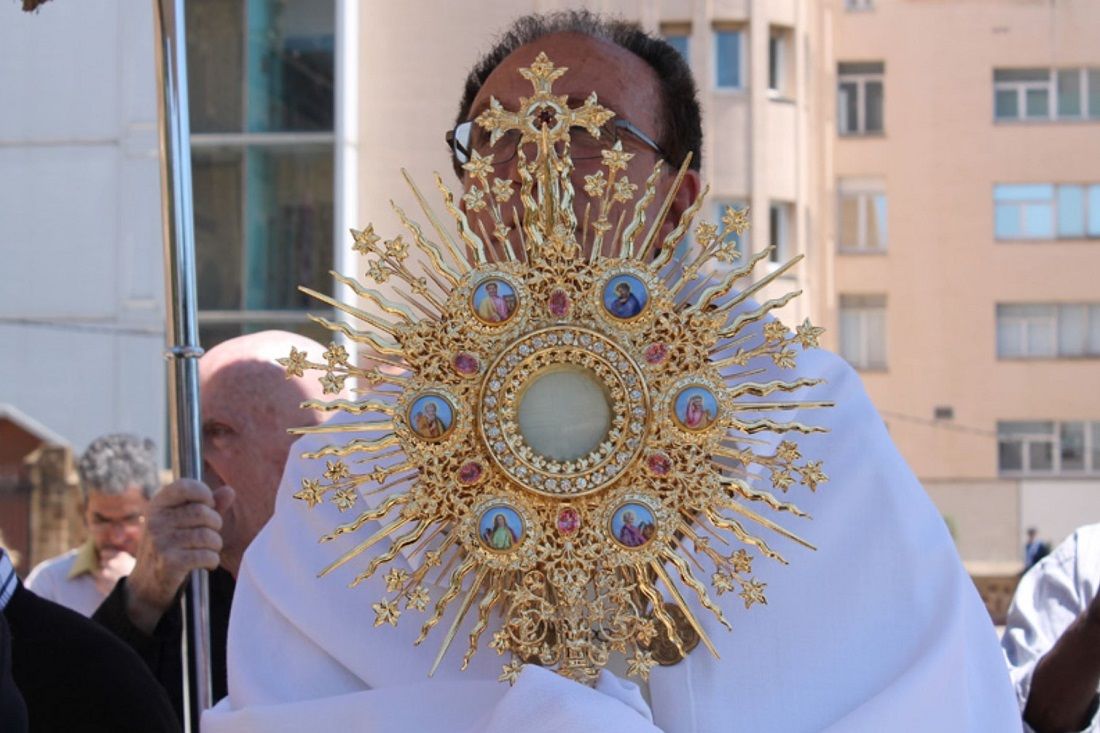
Beatified on September 3, 2000, Pope Pius IX encouraged the faithful to a special cult of the Blessed Sacrament in the French town of Faverney. Well, on the night of May 25/26, 1608, thousands of believers witnessed a phenomenon contrary to the laws of nature. The local Benedictines decided to introduce the practice of forty-hour adoration in the parish. Jean Garnier, one of the parishioners, was the last to leave the church before midnight. When he returned around three in the morning, at the site of the monstrance he saw a fire was already dying. Candles burned to the end started a fire that consumed the altar cloth and other liturgical items on the altar. Above the flames, suspended in the air, hovered the monstrance with the Host. During the 33 hours of the miracle, 10,000 believers came to bow to Christ in the Eucharist. The next day, the monstrance itself rested on the corporal, spread on the top of the scorched altar. The local bishop recognized the miracle in 1608.
In 1732 at La Scala, during the exposition of the Blessed Sacrament, the nuns saw a cross in the Host: first black, then blood-coloured, and then white. Finally, before their eyes appeared the image of the Saviour on the cross, as well as the view of a rocky mountain and the instruments of the Passion.
Two months later, St. Alphonsus Liguori, an eminent theologian and founder of the Congregation of Redemptorist Fathers, settled in this city with his companions. The men decided to spend the first three days of their stay in front of the Blessed Sacrament in the sisters’ chapel. Due to this event, St. Alphonsus chose as the coat of arms of the new congregation a cross accompanied by the instruments of the Lord’s Passion.
Let us add that in our century two similar Eucharistic miracles took place: in Saint-André-de-la-Réunion (1905) and in Castelnau-de-Guers (1974). In both cases, the faithful saw the Face of Christ instead of the white Host.
For some people, such visions are given as a grace, thanks to which their journey of faith in the Divinity of Jesus Christ begins. Let’s quote the testimony of a certain Jew who told his archbishop, St. Thomas de Villeneuve († 1555) – the following experience: “One day I was travelling with a friend, my peer. During the journey we talked about the person of the Messiah, whom we still awaited. We had a burning desire to see Him. Oh, how happy we would be if we could see Him with our own eyes! Night came and we continued our conversation on the subject. Suddenly we saw a great light in the sky. Recalling my father’s words that sometimes heaven opens and then you can ask God for the expected grace, we both fell to our knees and with all the piety we could muster, we asked the Lord to show us the Messiah. Then a shining chalice with the Host appeared in the sky, in the same form as during the Catholic Mass. At first, we were very frightened by this vision, but after a few moments the terror left us and we experienced great serenity and joy of spirit. Light penetrated our interiors, and we were filled with some deep understanding of these things. We thanked God from the heart. At the earliest opportunity, I was baptized in the Catholic Church and accepted Jesus as my Saviour.”
The Eucharist also works miracles invisible to the eye but evident to the human heart. This is how one could describe the reality of countless conversions that are constantly taking place in silence in front of the tabernacle in the churches of the world. There is a book in French about a world of outstanding intellectuals of our century, whose path from atheism to faith began precisely through contact with Jesus in the Eucharist.
These meetings were often bizarre, humanly accidental, like the one that took place in the life of André Frossard – a young atheist, son of the first secretary of the French Communist Party. Entering a certain church out of sheer curiosity, he saw ornaments and candlesticks above the main altar, dominated by a metal cross and a white circle below it.
“Never before,” recalls Frossard, “had I seen a monstrance or Host exposed, and at that time I had no idea that I was in front of the Blessed Sacrament. The meaning of it all was foreign to me. It was then that the avalanche of events began. I am not saying that the sky opened up: it tore open, it rose violently! A silent glow… The certainty of God… An eruption of light, a joyful drowning… All dominated by the presence of Him Whose Name I cannot utter without fear of offending His tender love; The one I was lucky enough to stand in front of as a child who was forgiven for everything: I am a Catholic!”
In the end, only thanks to faith we can stand before the white Host and confess from the bottom of our hearts: “Truly You are Christ, the Son of the living God!”. There is also one most solid foundation of our faith in the Eucharist, which is the word of Christ in the Upper Room: “This is my body; this is my blood.” We believe first and foremost because Jesus said so – He who is the only Truth. If we are looking for the surest support for our faith, it is precisely the Word of the Lord, spoken on Maundy Thursday. From the very beginning, the Church realized that the only condition for saving faith in the Eucharist from the turmoil of human doctrines and ideologies was trusting adherence with heart and mind to the Truth of Christ’s words. Faith opens the way to reason, which has its own way justifies what we first believed with our hearts.
If a trusting, almost childlike (in the sense of evangelical simplicity) faith in the Eucharist could be called poverty – this poverty is the greatest wealth of God’s people gathered around the Eucharist. Why poverty? Because what Christ said is enough for our faith. “Let no one be deceived,” admonished the Christians of St. Ignatius of Antioch in the 2nd century. “Even celestial beings, angels in glory, and powers visible and invisible are subject to judgment if they do not believe in the Body of Christ. How valuable is our faith in the Eucharist, since it delights God Himself!”
“When I was immersed in prayer – Sister Faustina writes in her Diary – I saw the glorious face of the Lord in the place of the monstrance and the Lord said to me: What you see in reality, other souls see through faith. Oh, how I love their great faith.”