Atheists, by denying the existence of God, also reject the idea of an immortal human soul. This perspective reduces the human experience to mere physical matter, where happiness is seen simply as the unlimited gratification of bodily instincts and needs.
Soviet atheists, for example, ridiculed those who believed in an immortal soul, claiming that if it existed, it could be detected through an X-ray. Some atheists assert that the human soul consists of material energy that can be studied scientifically. Conversely, others argue that it is merely a creation of the human brain or an illusion altogether. Questioning the existence of the human soul leads to treating people as objects, ultimately harming culture itself.
For instance, Theodor Adorno (1903–1969), a prominent figure in gender ideology, posited that humans are merely part of a drive, which divides into male and female. This notion laid the groundwork for the Marxist gender agenda that has sought to sexualise all aspects of life, including advocating for the sexualisation of children. Another theorist of gender ideology, Wilhelm Reich (1897-1957), argued for the abolition of all sexual restrictions, suggesting that the “image and likeness of God” should be expunged from humanity. He famously stated, “With the release from the contraction of the genital muscles, the idea of God should disappear,” proposing a “religion of orgasm” and “sexual mysticism.” According to him, the “true god” lies in “Love in the loins” and “the sweetness of devouring pleasures during intercourse” (W. Reich, The Murder of Christ, Milan 1972, p. 229; cited in Marzena Nykiel, Pułapka Gender (The Gender Trap), pp. 66-67).
The Mystery of the Human Person
Denying the existence of an immortal human soul challenges our fundamental cognitive logic. How do we come to understand its existence? When we speak of the human soul, we engage with the profound mystery of what it means to be human – encompassing self-awareness, freedom, thought, love, imagination, and creativity. Out of all creatures, only humans possess reason, free will, and self-awareness. We can explore both the macro and microcosms, engage in scientific inquiry, reason, judge, and formulate abstract concepts.
A clear indication of the spiritual aspect of humanity is our capacity for language, which employs grammar and logical reasoning – abilities that are absent in the animal kingdom. Moreover, while animals behave in instinctual patterns that remain unchanged over time, humans constantly advance in science and technology – from the abacus to the computer, and from the bow to spacecraft.
It is through our spiritual, immortal soul that we are rational and free beings, endowed with self-awareness and an openness to truth, love, goodness, and beauty. We possess a conscience and moral sensibility, allowing us to discern between right and wrong and to choose whether to believe in God. These expressions of spiritual life are lacking in animals, which do not possess a spiritual soul. The soul, as a spiritual entity, transcends the physical world and is immortal by its very nature, as God sustains it in existence.
Bilocation Facts
One of the arguments for the existence of a spiritual soul in humans is the numerous documented cases of bilocation in the lives of saints. Through a special gift bestowed upon them by God, saints were able to move their spirit to locations thousands of kilometres away to assist those in need. While their bodies remained in their place of residence, their souls could simultaneously be present elsewhere to provide specific help. Remarkably, this spiritual presence could be perceived by others, who were able to see and communicate with them.
One notable example of bilocation involves Saint Padre Pio. This account was verified during his beatification process by Father Damaso di Sant’Elia, the superior of the Pianisi monastery in Italy (cf. Positio III,1, pp. 689-690). Pilots of the Allied forces stationed near Bari in September 1943 reported that during their combat flights, whenever they approached San Giovanni Rotondo, they saw a monk appear in the sky. This monk prevented bombs from being dropped and redirected the planes. General Bernardo Rossini recalls, “When the pilots returned from their flights, they told me that at one point, a monk appeared to them in the sky, and then the planes immediately changed course on their own.”
The supreme commander, an American general, decided to investigate these reports personally. He led a squadron of bombers tasked with destroying a German ammunition depot located near San Giovanni Rotondo. The atmosphere was tense as everyone eagerly awaited the outcome of this mission. When the planes returned to base, the American general recounted that, as they neared the target, they suddenly saw a monk in the air with his hands raised. At that moment, the bombs inexplicably released from all planes and fell into the surrounding forests. The aircraft then turned back toward the base without any intervention from the pilots.
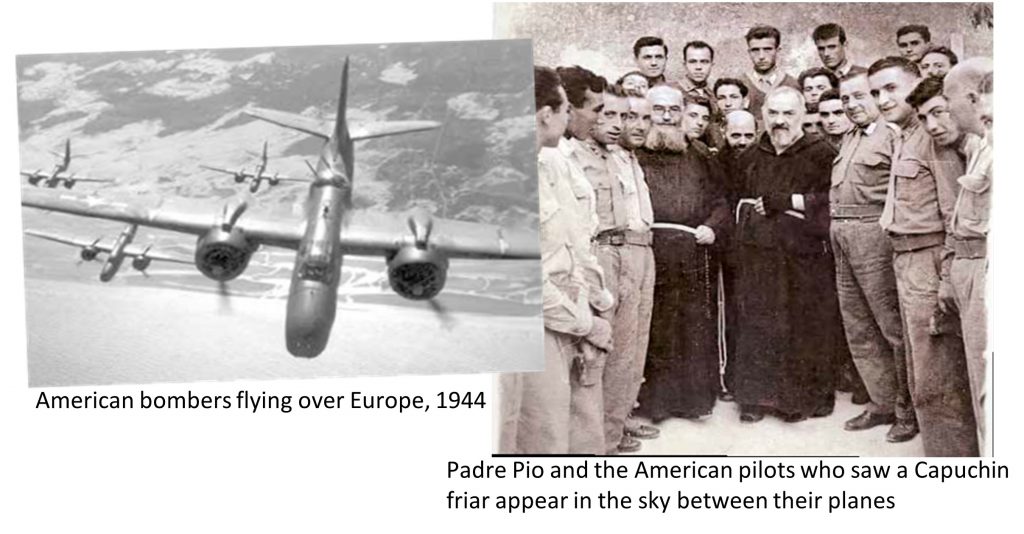
This extraordinary event quickly became the main topic of conversation within the unit. After the Germans retreated, the air force general visited San Giovanni Rotondo with several pilots. Upon arriving at the sacristy, he recognised among a group of monks the very one who had turned the planes around: Father Pio. As Father Pio approached the general and placed his hand on his shoulder, he remarked, “So you wanted to blow us all up!” The general was deeply moved by these words.
Despite the language barrier – the general spoke English while Father Pio communicated in his native dialect from Benevento – they shared a long and meaningful conversation. Following this encounter, the Protestant commander converted to Catholicism.
Experiences from the Border of Death
The phenomenon of souls appearing in purgatory to the living offers compelling evidence of the existence of the human soul and its continued existence after the body’s death. Many saints, blessed with the special gift of encountering souls in purgatory, have shared their experiences of these souls requesting prayers and atonement for their sins. It is crucial to note that experiencing such encounters is a unique gift from God. In contrast, attempts to summon the deceased through spiritualistic séances open the door to malevolent spirits, which can masquerade as the departed. These practices are dangerous, potentially leading to possession, and are considered a mortal sin.
The existence of the human soul and life after death are supported by accounts from individuals who have experienced clinical death, coming close to the threshold of actual death. Documented cases reveal that many of these individuals, upon returning to life, recalled intricate details of events that occurred during a period of complete brain inactivity. This strongly indicates that human consciousness is independent of the physical brain and persists after the body dies.
In their book Immortality: The Other Side of Death, authors Gary R. Habermas and J.P. Moreland discuss numerous cases, including those of blind individuals who encountered clinical death. One such blind person described, in remarkable detail, the resuscitation efforts of medical professionals, which he perceived through the “eyes” of his soul. Other blind individuals who had never been able to see shared similar experiences, noting details such as the clothing and jewellery of the medical staff involved in their resuscitation.
Currently, the most significant criterion for defining natural death is the cessation of brain activity for an extended period. Some cases have shown that encephalographic tests indicated a total cessation of brain waves, confirming brain death. For instance, there was a case in which a woman was declared dead based on such tests. Remarkably, three and a half hours later, as her body was being transported to the morgue, she regained consciousness and lifted the sheet covering her face. She later recounted that during the resuscitation procedures, she had been above her body and was able to see and hear everything clearly, detailing every aspect of what had occurred during her period of what was believed to be death. Medical professionals studied this case in detail and were astonished to find her account entirely accurate. This challenges the atheistic notion that human consciousness is solely a product of the material brain.
Four common features characterise the experiences of those who have survived clinical death:
- An awareness of being outside the body and a clear recognition of one’s personal “self.”
- A life review, in which individuals witness how their good deeds and thoughts deepen their relationships with God and others, while their bad actions lead to destruction and suffering. They experience the consequences of their behaviour, recognising that every harm inflicted on another also affects the perpetrator.
- Encounters with deceased relatives and friends, whom they instantly recognise. Communication occurs through a direct exchange of thoughts.
- For many, the experience diminishes the fear of death. When instructed by a Being of Light or deceased loved ones, their return to their physical bodies is often met with reluctance.
The accounts of those who have experienced clinical death reveal that the majority undergo a profound transformation. The existence of God becomes a central truth for them, leading to a firm belief in heaven, hell, and purgatory. They recognise the uniqueness of earthly life and often lose their fear of death, realigning their lives with divine expectations.
Nobel Laureate on the Human Soul
John Carew Eccles, an Australian neurophysiologist and recipient of the Nobel Prize in Physiology or Medicine in 1963, is regarded as one of the foremost authorities on human brain research. His scientific findings led him to conclude that every individual possesses an immortal soul. Eccles demonstrated that human consciousness is not a product of physical matter, as matter alone cannot produce psychic phenomena and does not facilitate the transition from physical energy to psychic experience. Only the spiritual realm can generate such experiences. He rejected the materialists’ claim that thought arises from material processes, asserting it as a superstition unrelated to scientific findings: “The more scientific research reveals the truth about the functioning of the human brain, the more clearly we can distinguish its functioning and thinking — and in this context, we can see how wonderful the phenomenon of thinking is. The belief that thinking is the result of material processes is simply a superstition maintained by dogmatic materialists” (The Wonder of Being Human: Our Brain and Our Mind, San Francisco 1985, p. 24).
Eccles emphasised the presence of a personal “I” in every individual — a non-material mind that interacts with the physical brain. He posited the existence of both a physical and a spiritual realm within humanity, where these two realities engage with one another (cf. How the Self Controls Its Brain, p. 38). He noted that the self-awareness of the personal “I” remains constant throughout one’s life, recognising this as a miraculous truth (ibid., p. 139). “Since the materialistic conception,” Eccles stated, “is incapable of explaining and justifying our unique experiences, I am compelled to accept the supernatural creation of a unique, spiritual, personal ‘I’ — that is, the soul. To put it in theological terms: each soul is a new divine creation implanted in the human embryo” (Evolution of the Brain, Creation of the Self, p. 237).
Man as a unity of soul and body
At the moment of fertilisation – the union of male and female cells – God creates an individual, immortal soul. This soul does not perish when the body separates from it at death. Thanks to the immortal soul, humans carry the image and likeness of God within themselves, containing the seed of eternity that “cannot be reduced to matter alone” (Second Vatican Council, Gaudium et spes, 18).
From the moment of conception, the harmonious development of a human being is guided by the “information” (genetic code) present in every cell of the body. This brilliantly encoded “information” organises the growth of the body, directs its development, and gives it purpose. It signifies the existence and action of the individual human soul, which unites, animates, and shapes matter so that it becomes the body of a specific person. The soul is manifested in the human body and, as a spiritual reality of the personal “I,” is present in every cell of the human body. In the Catechism of the Catholic Church, it is stated: “The unity of body and soul is so profound that one can consider the soul to be the ‘form’ of the body. This means that, thanks to the spiritual soul, the body, which is made of matter, becomes a living and human body. In humans, spirit and matter are not two separate natures joined together; rather, their union creates a single nature” (CCC 365).
Scientists have found that every seven to nine years, there is a complete exchange of all the atoms in the human body, including those in the brain. Despite this constant renewal, we do not become entirely new individuals within that timeframe. What maintains our identity over time and our continuous self-awareness of an unchanging “I” is the spiritual soul, which serves as the principle of unity.
Human beings exist as a unity of soul and body, and we cannot dismiss the body as mere excess. Contemporary theologians explain that the body acts as both a symbol and a manifestation of the soul. The immortal human soul maintains a constant relationship with the material body and even, after death, “awaits” its resurrection. As Pope Benedict XVI taught, possessing a soul signifies that a person is wanted, known, and loved by God, and that they are called to engage in an eternal dialogue of love with Him. If a person completely rejects this call, persists in sin, and refuses to accept God’s infinite mercy for forgiveness, they ultimately lead a life that results in the greatest misfortune: an eternal existence in absolute selfishness. By consciously choosing evil, an individual can completely extinguish their capacity to love and break the bonds that connect them to God and others, effectively choosing hell for themselves. However, they cannot annihilate their existence; the personal “I,” upheld by God, is indestructible. While a person can take their own life, they do not possess the power to destroy their soul.
Holy Scripture on the immortality of the soul
Adventists and Jehovah’s Witnesses, claim that at the moment of death, the whole person – both soul and body – ceases to exist. They argue that the notion of an immortal soul stems from Greek philosophy rather than Scripture. This perspective arises from a misinterpretation of biblical texts. A careful examination of the Holy Scriptures reveals a clear message throughout both the Old and New Testaments affirming the immortality of the human soul.
The Gospels capture Jesus’ words, which strongly indicate that the human soul continues to exist after physical death. He tells his disciples: “Do not be afraid of those who kill the body but cannot kill the soul. Rather, be afraid of the One who can destroy both soul and body in hell” (Matthew 10:28). The fact that “they cannot kill the soul” confirms the belief in its immortality.
The conversation between Jesus and the good thief while Jesus is on the cross illustrates the belief that life continues after physical death. When the good thief requests, “Jesus, remember me when you come into your kingdom” (Luke 23:42), Jesus replies, “Truly, I tell you, today you will be with me in paradise” (v. 43). Here, Jesus uses the term “paradise,” which signifies a state of existence after death and prior to the resurrection of the body. His assertion that “today you will be with me in paradise” indicates that this union will occur immediately after death – essentially, “before sunset,” when the body has succumbed to death. The resurrection of the body, according to scripture, will take place “on the last day” (John 6:54). Therefore, in His words to the good thief, Jesus clearly affirms that the immortal human soul continues to live after the body dies.
Similarly, Jesus speaks to Martha, the sister of the deceased Lazarus, conveying the same message about the continuity of life: “I am the resurrection and the life. He who believes in me, though he may die, he shall live. And whoever lives and believes in me shall never die. Do you believe this?” (John 11:25-26). Additionally, Jesus reassures us of life after death when He states, “Truly, truly, I say to you, if anyone keeps my word, he will never see death” (John 8:51).
Saint Paul discusses the relationship between the mortal body, referred to as “soma,” and the soul, which he describes using the terms “psyche” and “pneuma.” These terms represent principles of supernatural life, as expressed in his words: “Your spirit, soul, and body” (1 Thessalonians 5:23). In his First Letter to the Thessalonians, he further elaborates on Christ, stating, “who died for us, so that whether we are alive or dead, we may live together with Him” (1 Thessalonians 5:10). This statement affirms that even when the body dies, the individual remains alive through their spiritual essence or soul.
When a person neglects their spiritual life during their time on Earth; when they fail to nurture loving relationships with God and others; when they do not strive against sin, refrain from praying, overlook God’s mercy, and avoid the sacraments of penance and the Eucharist, they begin to pursue only the desires and whims of “the flesh and of the mind” (Ephesians 2:3). Such a way of life inevitably leads to the most profound tragedy: a state of absolute egoism or eternal damnation.
Paul explains, “For the mind set on the flesh is death, but the mind set on the Spirit is life and peace. This is because the mind set on the flesh is hostile to God; it does not submit to God’s Law, nor can it do so. Those who live according to the flesh cannot please God. […] For if you live according to the flesh, you will die. But if by the Spirit you put to death the deeds of the body, you will live” (Romans 8:6-8, 13).
03/05/2022