A TESTIMONY
“You are my God. You’re supposed to take care of me. How can you leave me in these evil hands? I don’t know what these people are trying to do to me, but I know that You will be with me and one day I will see and meet You”.
“Carrying” the Quran
More than two billion people in the world have never heard the truth about Jesus Christ. Mustafa was one such person, whose childhood took place in the religious atmosphere of a Muslim home in southern Egypt.
At the age of five, the boy began his education under the guidance of his uncle. It involved reading and memorising the entire Quran in classical Arabic. Previously, Mustafa had heard this book read many times in the mosque or on the radio. Moreover, his parents sometimes invited people who specialized in reciting the Quran to their house, paying them handsomely for it.
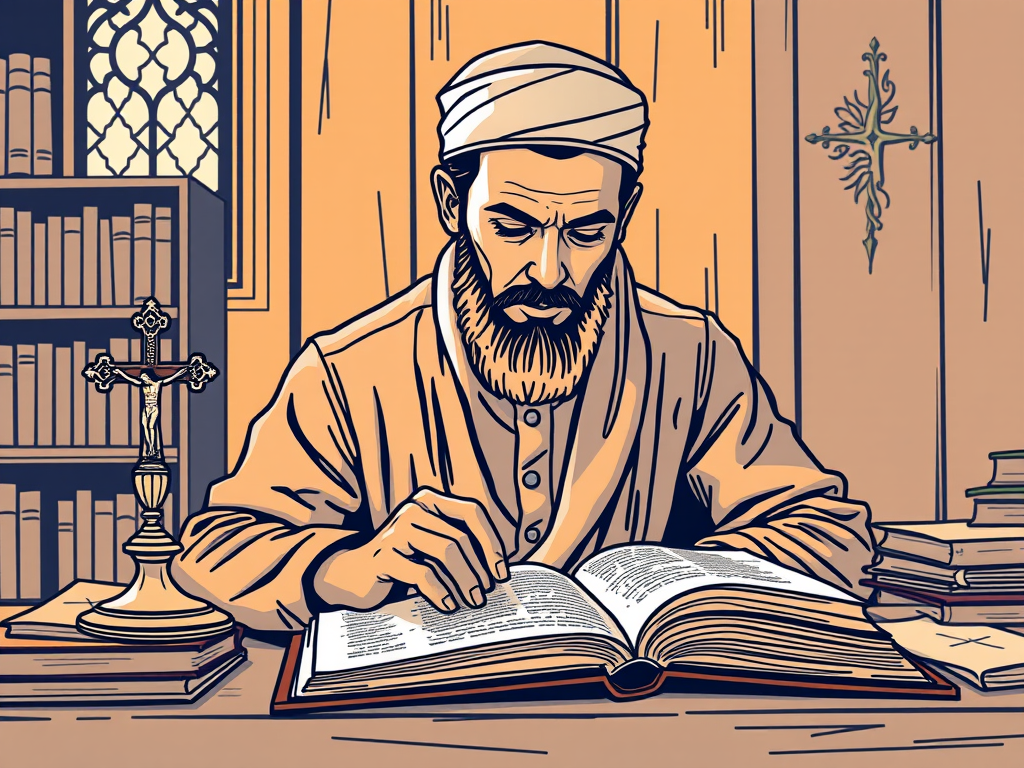
Mustafa was a gifted student, even though the language he used on a daily basis was very different from the one he encountered in the Quran, and it took him seven years to learn the entire book by heart. Thanks to this, when Mustafa was 12 years old, he began to be called hafiz – “carrying” the Quran, although until he graduated from high school, as he admits, he didn’t know the meanings of many words of this book. The career of a Muslim scholar was open to him, and in this area, he began to be called a little sheikh (a Muslim cleric).
When the boy was 13, something happened that significantly influenced his later spiritual life. As Mustafa admits in one of his interviews, at that time he felt a lot of anger towards Christians and Jews, which was born within him under the influence of the teaching he received at school. He heard many times, especially from religious teachers, that the source of all the problems Egyptians face are Jews and Christians. The young boy began to boil. The opportunity to repay the “wrongs” suffered at the hands of Christians came very quickly. There was a Coptic priest in the area where he lived. Every day he walked along the road from his house to the church. Mustafa decided to take advantage of this. One day he started throwing stones at him. The priest was taken to hospital with a bloody head. After leaving the hospital, he came to his house – because he knew his family – to talk to the boy. For Mustafa, this meeting was a surprise: for the first time he saw that the Christians did not seek revenge, nor did they want to treat him in the same way as he treated them. The priest came to Mustafa to say that he forgives him. “There is a fire inside you,” he said to the boy, “that must first consume you before it burns others.” This meeting made a huge impression on Mustafa.
Intellectual honesty
In high school, Mustafa continued to learn about the Muslim tradition by learning the hadith by heart – shorter or longer sayings or stories from the life of Muhammad and his companions. During this period, he memorized several thousand of them. It was therefore not surprising that after high school he enrolled at Al-Azhar, the university with the greatest authority in the Islamic world.
The first day of classes at the university was a great surprise for Mustafa: “The Shaikh who was giving the lecture (…) told us: ‘What I tell you should be considered the truth. I do not allow any form of discussion in class. What I don’t tell you is not worth knowing. Listen and obey and ask no questions.” The lecturer’s arrogant attitude really affected the newly admitted student. Mustafa came forward and asked, “Shaikh, how can you learn without asking questions?” Instead of an answer, he heard an offensive retort. The student complained to the dean of the university, who skilfully resolved the conflict. From then on, he writes, he entered on “the path of silence and subordination required at the university.” The method of study was based on reading the works of Muslim scholars, from which key points were then drawn up to be memorised. No criticism or discussion was allowed.
However, soon there were further misunderstandings between Mustafa and the lecturers. One of them was Omar ‘Abd Ar-Rahman, the organizer of the bombing of the World Trade Centre in 1993, who dealt with issues of Koran interpretation at Al-Azhar University. Surprisingly, it gave students the opportunity to ask questions. Mustafa stood in front of five hundred others and asked, “Why do you keep teaching us about jihad? What about other verses in the Quran that speak of peace, love and forgiveness?” In response, he heard: “Jihad and killing are the basis of Islam. (…) There is a surah in the Quran called Booty (the spoils of war), but there is no surah called Peace.” This terrifying, categorical answer gave the student no peace. . .
After four years, Mustafa graduated second in the course among six thousand students. When he started working at the university, he decided that from now on he would look for answers to the questions that bothered him, noticing the increasing dissonance between what true Islam offered him and what his own conscience told him. . .
His master’s thesis concerned issues related to the history and culture of Islam. While collecting materials and researching the topic of Muslim rule, Mustafa was faced with the undeniable fact “that Muslim history is a story of violence and bloodshed from the time of Muhammad to the present.” Despite this, he decided not to openly question Islam, about which he had increasing doubts. His research attracted the interest of the Egyptian government, which wanted to broadcast a live coverage of his defence of the thesis on a radio station.
Success and spiritual emptiness
In his religious environment, Mustafa undoubtedly achieved great success. He began writing his doctorate and giving lectures at Al-Azhar and other universities in the Middle East. However, he decided to allow his students to have discussions, wanting to open them to critical thinking without fear of reprisals. Soon, radical students reported him to the university authorities. They felt offended that, based on generally known Muslim sources, he demonstrated the cruelty and inconsistency of Islam as a religious ideology.
Mustafa was summoned to a meeting with the University’s Curriculum Implementation Committee. He told the audience about his doubts about the divine origin of the Quran. He mentioned that he began to see more human ideas than God’s words. It didn’t take long for a reaction: one of the committee members got up from his chair and spat in his face, saying: “You blasphemer!”.
Several hours later, in the middle of the night, an Egyptian commando broke into Mustafa’s house and took him for interrogation. The young Muslim was imprisoned on suspicion of “betraying Islam” and becoming a Christian. Such a “crime” in Egypt is punishable by death. The torture he experienced was, as he later wrote, “the final trigger, the nail in the coffin that separated me from Islam, a religion I had questioned for many years before my imprisonment. My questions were not based on the deeds of Muslims, but on the deeds of Muhammad and his successors and the teachings of the Quran.”
In prison, they tried to cause Mustafa’s “natural” death by locking him in a tank full of hungry rats. The policemen were very polite. “This guy is a Muslim thinker,” they said, “so let the rats eat his head.” But when by morning not a single rat had even bitten Mustafa, he was locked in a cell with a huge wild dog. Filled with despair, Mustafa prayed: “You are my God. You’re supposed to take care of me. How can you leave me in these evil hands? I don’t know what these people are trying to do to me, but I know that You will be with me and one day I will see and meet You”.
The next day, astonished policemen saw Mustafa praying and a dog sitting next to him. They said with horror: “This man is protected by an invisible power. But whose power is this? After all, he is an apostate, an infidel!” Definitely Allah could not be the one who protects the apostate.
Thanks to his uncle’s strong connections, after two weeks in prison and many painful tortures, Mustafa was released and cleared of all charges. For him, freedom was not a simple return to normal life. His life was in ruins. For a resident of the Middle East, the lack of religion and the denial of one’s heritage is a terrible blow. Islam – starting with its founder and ending with university lecturers – has completely discredited itself in the eyes of this man seeking truth. Therefore, he began to research other religions, primarily Hinduism and Buddhism, but he did not find the answer to his search in them. Mustafa was going through a period of real struggle and darkness, worse than an Egyptian prison. At the same time, his heart grew hungry to know the God who did not abandon him but allowed him to miraculously survive mental and physical torture in prison and thus showed that he cared for him. “I would sit on my bed or at my desk, praying that the true God who saved me while I was in prison, whoever he was, would reveal himself to me. Sometimes I couldn’t say a word, I just sat there and cried.”
Headaches
During this time, Mustafa’s recurring headaches also became more severe. The nightmares of prison life were coming back to him. During the day, the pain was unbearable, and Mustafa was able to work in his father’s company, but in the evenings and at night he could not sleep because of it. So, he began to visit a certain pharmacy run, as is often the case in his country, by Christians. One day, the owner, seeing his inner conflict, started talking to him about faith. Knowing him as a religious Muslim, she was astonished to hear his story about his search for God. She understood that he had discovered a void in his previous religion that he wanted to fill. So, she decided to give him her Bible. “Before you take your pills this evening, try reading a passage and see how you feel,” she said to her patient.
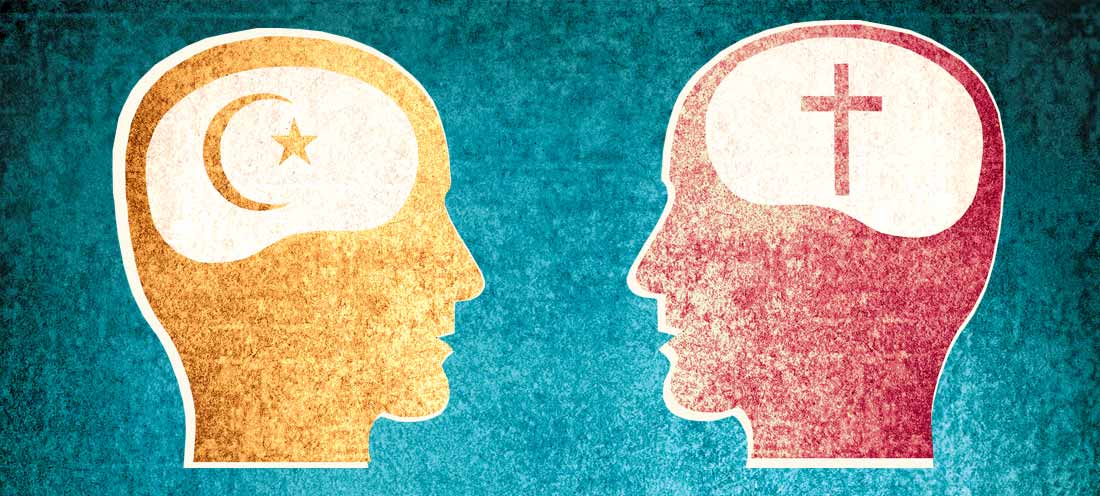
It was a breakthrough evening in Mustafa’s life. This is how he remembers that day: ‘It was a summer night, around 10 p.m. I had an intense headache, but I didn’t take any pills. I placed them on the desk and looked at the Bible. I didn’t know where to read, so I just opened it at random. It was the pharmacist’s personal Bible; with notes she had made in the margins of the pages. I opened it to the fifth chapter of the Gospel according to St. Matthew, Sermon on the Mount. I started reading. I saw an image: Jesus teaching the crowds gathered around Him on the mountain. (. . .) My brain started working like a computer. I saw an image of Jesus in a book on the desk across from me. I saw an image of Muhammad in my mind. I compared these two characters all the time. I knew the Quran and the life story of Muhammad so well that I did not have to make any effort to recall these things from my memory. They were just there.”
Up to this point, for Mustafa, Jesus was only one of the prophets described by the Koran who never interested him. Reading the Holy Scriptures that evening, he understood that Jesus Christ was the true God whom he had been looking for all his life. The most shocking discovery for him were Jesus’ words: “Love your enemies.” Until now, Mustafa was convinced that enemies should be killed. Jesus touched his heart with the power of His forgiving love that nothing could stop. Reading the Gospel, Mustafa discovered the powerful love of the Son of God towards sinners whom Jesus did not order to be stoned, but whom He welcomed, accepting their tears of conversion.
New life and new identity
Mustafa was so absorbed in reading the Gospel that he read it through to dawn. He became so fascinated by the person of Christ that he entrusted his entire life to Him, knowing that he might pay a high price for it. However, he knew that Jesus would never disappoint Him – he had already seen this in prison, and this confidence grew in Him as he read the Holy Scriptures. He read the words of Psalm 91 as God’s response to him: ” For he will deliver you from the snare of the fowler and from the deadly pestilence; he will cover you with his pinions, and under his wings you will find refuge; his faithfulness is a shield and buckler. You will not fear the terror of the night, nor the arrow that flies by day, nor the pestilence that stalks in darkness, nor the destruction that wastes at noonday”. A thousand may fall at your side, ten thousand at your right hand; but it will not come near you.”
Over the next year, Mustafa tried to join one of the Christian communities in his region. However, he was bitterly disappointed when subsequent clergy refused him, out of fear for his life and that of his community. As a former Al-Azhar lecturer, he was a recognisable figure in many circles. Finally, someone trusted him and allowed him to attend their church. Taking care of his own safety and that of the Christian community that took him in, Mustafa had to take extreme precautions. While traveling, he changed means of transport. He also avoided places where someone might recognise him. However, it is impossible to “hide the light” (see Mt 5:15). . .
He recalls: “It was only a matter of time before my family found out about everything. One day, completely unplanned, I revealed everything to my father. He immediately pulled his revolver from its holster and fired five bullets at me.” However, none of the bullets hit Mustafa. God protected him once again.
Mustafa had to leave his country in a quickly organized escape, traveling across Africa from Egypt to South Africa in three months. But he was also pursued there by paid killers. Mustafa once again experienced the extraordinary protection of Jesus Christ, who led him to salvation, according to His own promise: “Whoever believes and is baptised will be saved” (Mark 16:16). Only now, in one of the churches in Johannesburg, could he be baptised. In honour of Saint Mark the Evangelist he took the name “Mark”, and because of a friend who helped him in South Africa – the surname “Gabriel”. Thus, immersed in the death of Christ, he was born into new life by His Resurrection. Becoming a new man, he took on a new identity to serve only Jesus with his entire life.
The harvest is great
As he came to know Jesus Christ, Mustafa continued to compare Him with the well-known Prophet Muhammad, until ultimately the loving and forgiving Son of God won unequivocal victory in the life of the Muslim academic. It was He who conquered death and said: “Do not fear those who kill the body but cannot kill the soul” (Mt 10:28). That’s why Dr. Mark A. Gabriel chose the difficult path of faith in Christ. Aware of the fact that he is subject to a fatwa (death sentence for abandoning Islam), he boldly shares his testimony of faith to attract as many of his Muslim brothers and sisters to the Saviour as possible.
Mark confesses: “For 34 years I lived in fear of Allah’s punishment. By giving my life to Jesus, I was redeemed by His Blood”. Meeting Jesus for the first time in his life, he felt great relief because he was freed from the burden of guilt that weighed on him despite his adherence to the principles of Islam. While researching Muslim tradition, Mark discovered that Muhammad himself was unsure whether he would be saved and accepted into paradise. So, if the prophet of Islam did not have this certainty, what should an ordinary Muslim say?
Mark A. Gabriel addresses all people: “Brother and Sister! (…) Only Jesus Christ can give you peace and forgive your sins. Consider the poor conditions Muslims live in all over the world: hatred, bloodshed, killings, conflict and terrorism. The only way out of this chaos is to accept Jesus Christ as your Lord and Saviour”.
The greatest misfortune of humanity is sin, from which only the sinless Son of God could redeem us. Jesus Christ is the solution to every problem: individuals and all people. Let us trust Him, be reconciled with Him and proclaim to others salvation through His redemptive death and resurrection. We have a great responsibility for the salvation of all those who have not had the opportunity to hear the Gospel. Yet we don’t have to pay such a high price as Mark A. Gabriel.