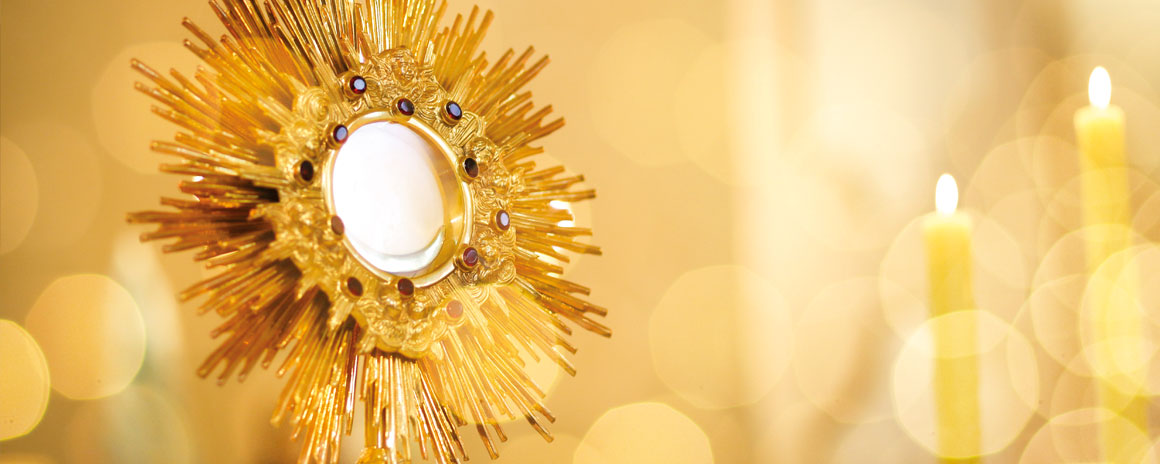
 Saint Pascal Baylon, before being acknowledged as a saint, went from monastery to monastery, wanting to become a monk. He was not wanted anywhere because of his exceptional lack of beauty and strange clothing.
Eventually, however, he found a Franciscan community in which he became a religious brother. Above all, he loved adoration: during the day he was engaged in simple services, and in the evenings and nights he spent in front of the tabernacle.
He was born on 15 May 1540 (the feast of Pentecost) and he died on May 17, 1592 during Holy Mass (on the feast of Pentecost), as the priest raised the consecrated Host. Pope Leo XIII made him the patron of Eucharistic Congresses.
A specialism of Saint Pascal was his daunting presence in the church. A certain prince who during a devotional service was talking with his neighbour in a pew found out about it. Outraged by this, the celebrant, not having the courage to call to attention the eminent parishioner, asked Saint Pascal to get them in order.
Then, before coffin with the remains of a brother, there was a terrible thud reverberated. The prince was so scared that the desire to talk during the Holy Mass left him forever.
A similar lesson was learned by the sacristan, who moved around the church without reverence. Once reprimanded by the saint, he learned to genuflect before the tabernacle.
Bending the knee before the Blessed Sacrament is more than an outward gesture. The word “adore” comes from the Latin word for “mouth” and the equivalent Greek word “adore” also means a kiss. Adoration is therefore an expression of worship given with love.
Despite all kinds of difficulties and obstacles that we encounter during private adoration (time pressure, scattered thoughts, inner dryness, etc.), staying before Christ in the Eucharist is still a time of love.
Measuring the value of this prayer according to the type of thoughts or moods that arise in us would be a lack of faith. But faith in the real presence of Christ in the consecrated Bread makes us recognize that it is above all He who loves us and looks into the depths of our being.
Cardinal Raniero Cantalamessa, the preacher of the papal house, calls adoration the intersection of two gazes: Christ’s and ours. If our gaze fails at times, His gaze never fails.
Sometimes adoration comes down to simply being in the company of Jesus, to remaining under His gaze, to giving Him the opportunity to rejoice in looking at us, who, despite the status of sinful creatures, are the fruits of His passion.
In a mysterious way for us, Christ rejoices in being in our presence. Adoration is a time to celebrate Jesus! This truth undoubtedly surpasses us, but it also makes us recognize the inestimable value that we represent in His eyes.
By looking at Him, we allow Him to look at us first. Our loving gaze upon the Host is His gaze in return: we love Him because He first loved us.
While simply being under the watchful eye of Jesus looks like inactivity, it is not.
“The power of his gaze,” writes St. Gertrude – results in humbly recognizing our own weakness and sinfulness, joy from the greatness of His mercy, healing from hardness and insensitivity, the ability to accept various graces and fulfil God’s will.
From St. Gertrude we find another very uplifting message. She wrote them down under the dictation of Jesus himself, who confessed to her that He greatly appreciated and rewarded our every look at His Eucharistic Face.
“How many times a person looks with love and respect at the Host, which sacramentally contains my Body and Blood, so many times does he increase his future merits. In the Kingdom of God, they will taste joy, a new and special reward for every glance directed at the Blessed Sacrament”.
Isn’t adoration on earth a pledge and assurance of seeing God in heaven? Although during adoration we are tired and sometimes also discouraged, none of this time is wasted. The body, feelings and thoughts are unable to comprehend the unspeakable reality that takes place inside the soul.
Hans Urs von Balthasar – one of the greatest theologians of our time and also a man of contemplation – explains that the secret of adoration belongs to God, not to us. He puts the following words into Jesus’ mouth:
“My kingdom unfolds within you, though it takes place outside your eyes. I am the King and centre of all hearts, and I alone know the deepest secrets.
“You see only the outer shell behind which you hide one from the other. I, on the other hand, see souls from the inside, from the interior, where their true face is. There, in the depths of your souls, shines your gold, your most precious jewel. There is written the title of your greatest dignity and nobility. There, spiritual eyes are constantly staring at the face of the Heavenly Father. There, even when the body and consciousness fall asleep, the eternal light in front of the tabernacle is constantly watching.
“The outer face of men is twisted and awkward, but the inside is admirable. And when people truly love each other, their inner face shines before Me. I then receive gifts greater and more valuable than those they exchange among themselves. All the good in them, even when they do not see it or recognize it because of a certain shyness, turns to Me.
The incomprehensible beauty of souls, which the Father hides from them so that they do not appropriate it for themselves – this beauty, the most sublime of all, right after the beauty of God Himself, is present without a veil before my eyes. What a splendour of this sight: in the vast sphere around my Heart, millions of hearts bloom like a giant rose, sighing for the Sun amidst the struggles and dangers of the night, amid constant fears, adversities, hesitations, falls and rises. And all these hearts are turned to Me.”
The emergence of new centres of Eucharistic life, new places of adoration and communities is a tangible proof of Jesus’ action and His desire to embrace us all.
In the past issues of our bulletins, have been published various testimonies about the miraculous transformation that takes place in human hearts and entire environments thanks to the adoration of the Blessed Sacrament.
Adoration in parishes is again on the increase, but yet more is possible and needed. Thanks to this initiative, more and more good will be born: Jesus will give concrete proofs of his love and power.
However, since these signs are intended to stimulate all of us to greater faith in His living and effective Presence, you are encouraged to share your testimonies. Let’s remember that Jesus still works the same way: through teaching and signs. Let Him work through us too.