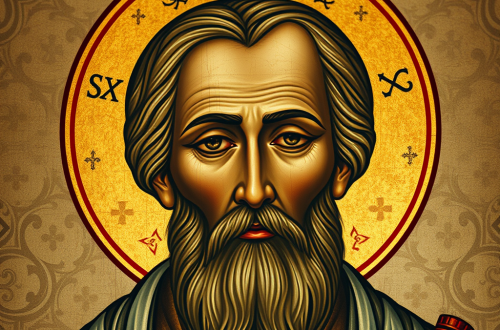

Saint Teresa of the Child Jesus says concisely: “Prayer is a lifting of the heart, a simple look towards Heaven, a cry of gratitude and love, both in suffering and in joy.” To put it even more simply: someone who turns to the Lord with faith and love prays.
Who can we learn to pray from?
The Lord Jesus is our teacher. When the disciples asked Him: “Lord, teach us to pray” (Luke 11:1), then in response to this request, Christ the Lord uttered the words of the most important and most beautiful prayer – the Lord’s Prayer – Our Father.
We are to pray this prayer every day and shape our lives according to it. Blessed and happy is the person in whose life all seven petitions of the Lord’s Prayer are fulfilled!
In the Gospel, the Lord Jesus teaches us to pray always; prayers submitted to the will of the Father; prayers for enemies. Prayer is not difficult. Even a small child can pray.
And yet Saint Paul the Apostle tells us that without the help of the Holy Spirit we cannot pray – truly pray. One of the seven gifts of the Holy Spirit is piety – the ability to pray. You have to ask for this gift and open yourself to it.
The books of Scripture, especially the Book of Psalms, teach us how to pray. Written centuries ago, they remain a living and contemporary prayer for each of us.
We can learn prayer from Our Lady, from the saints, and from people who received the gift of prayer from God. Parents have a duty to teach their children to pray. The grace of the sacrament of marriage helps them.
When is our prayer good?
When assessing prayer, we can’t be guided by our feelings. Sometimes it seems to us that our prayer is unsuccessful, sometimes we’re satisfied with it. However, remember that these feelings may be very unreliable.
Our changing feelings are not important, what is important is God’s judgment: whether our prayer can please God. A good prayer is faithful – that is, I pray it every day; continually – that is, not to get discouraged; humbly – that is, I remember that here I am, a sinful and limited person, standing before a holy and incomprehensible God.
The Lord Jesus asks us to pray with faith and be open to the will of God, our Father.
What mistakes do we most often make in prayer?
We make a mistake if we do not do what is written above about good prayer. The Lord Jesus warns us not to approach prayer with a heart in which there is no forgiveness for our neighbour (cf. Mk 11:25) and no will for reconciliation (cf. Mt 5:24-25).
It is a great mistake in prayer not to seek God, but yourself, your own satisfaction, your purely earthly benefits. We are to pray for the sake of God, trying to submit as much as possible to His will and unite with it.
What are the types of prayer?
There is a prayer of request, conciliation, thanksgiving and praise. These last two are more difficult and less frequently practiced on earth, but they will be our only and constant prayer in heaven.
We’re talking about the prayer of the Church, that is, liturgical prayer, and personal, “private” prayer, but it also has its important place in the Church. When praying individually, we can pray in our own words, but we can also – and should – use prayers practiced and written by saints or pious people endowed with the gift of prayer.
However, it must be remembered that these prayers can’t be said only with the mouth. They must flow from our hearts. When praying, let’s not use big words without any interior basis.
What does the liturgical prayer of the Church mean?
It is primarily the Mass and the Eucharist, but also the celebration of other holy sacraments, as well as the Liturgy of the Hours, consisting mainly of psalms. The most important parts of this liturgical prayer during the day are matins and vespers and the prayer before retiring – called compline.
The shape of these prayers is determined by the shepherds of the Church – the Pope and bishops. This is the official prayer of the Church and cannot be changed at will.
What can we pray for?
About everything that is good. Jesus says: ” If you ask anything of the Father, he will give it to you in my name” (Jn 16:23).
However, we cannot limit our prayers to what is worldly. Of the seven requests of the Our Father prayer, only one – for daily bread – concerns material matters. Christ encourages us to ask for the gifts of the Holy Spirit: ” And I tell you, Ask, and it will be given you; seek, and you will find; knock, and it will be opened to you… if you then, who are evil, know how to give good gifts to your children, how much more will the heavenly Father give the Holy Spirit to those who ask him!” (Luke 11:9, 13).
Why do we think some of our prayers remain unanswered?
There is no unanswered prayer, although there are prayers that do not fulfil our wishes.
God is Wisdom itself and Good itself. He looks not only at our life on this earth, but at the whole of our existence, which is eternal. The human soul does not die! Being only good, God does not give us while here on earth what could harm us, especially the life of grace in us, our soul, salvation.
God has eternity to accomplish the good that He intended for us and to satisfy our greatest and deepest desires.
We must also remember that God gave us free will. We are free beings. Therefore, God does not change the consequences of human actions just because we sometimes would like it to be that way.
If, for example, a student does not study but only prays that he will have a successful exam, this is not a prayer at all, but taking God’s name in vain, which is prohibited by the second commandment.
When speaking about the fulfilment of our requests (cf. Jn 15:7), the Lord Jesus mentions two conditions.
The first: “if you abide in me” – the one who receives His Body, Holy Communion, abides in Christ – and the second condition: “if My words abide in you” – the word of God abides in us when we listen to and read the Holy Scripture, when we retain the knowledge we have learned and put it into practice.
Lord Jesus prayed only to God the Father. Why do we pray to Mary and the saints?
The Lord Jesus prayed to God the Father, who is both His and our Father. Coming to earth, He fulfilled the will of His Father. He did it out of love for Him and out of love for us.
Being in a relationship of love with the Father, He talked to Him, and the disciples, and other people observing this, could learn to pray in this way. The Gospels record the requests of various people addressed to Jesus – the Son of God. These requests were prayers.
Jesus Christ is the only Mediator between us humans and God the Father. When Jesus, our only Saviour, was dying on the cross, he gave us his Mother as our Mother.
It was Mary who asked for Christ’s first miracle at Cana of Galilee. Being our Mother, she takes maternal care of everyone she knows, prays for us to God, reigning in heaven.
The saints, also, especially our patrons, standing before God in heaven, intercede for us. Face-to-face with God, with our worries in mind and hearing our requests, and seeing them in “God’s way”, and praying constantly, they unites themselves to our requests, somehow “straightening them out” so that they are consistent with God’s will and bring us the greatest good. When we pray “to” the saints, we are actually praying for their intercession before God.
Why do we need to pray and take time to pray?
Prayer is one of the most important – if not the most important – matters in our lives. Without prayer, no consciously living person will be saved. We cannot be saved by our own strength – we need God’s grace to be saved.
Without turning to God every day, without meeting Him in prayer, none of us will be able to live in faith, hope and love – to be and remain a Christian.
03/12/2023