If there is Christ in the Church, if the transforming Word of God is preached within it, if the sacraments administered in it, if thanks to the gift of the Eucharist the humanly unattainable union with Christ is available – then why is there so much evil in the Church?
Living in the 5th century, Saint Fulgentius drew attention to the futility of this question – after all, we know very well that our sins are the source of evil. Another question is really important: what to do in the face of the evil we see in the Church? Fulgentius replies as follows: “Hold on to it as much as possible, and do not doubt at all that the Catholic Church is God’s threshing floor, where until the end of time there is wheat mixed with chaff, that is, throughout the sacramental community, the good are mixed with the bad. In every state, among the clergy, among the monks, among the laity, there are good and bad. Now, the good cannot be abandoned because of the evil, but the good must endure the evil. No one who has proper faith and lives well in the Catholic Church can ever be stained by the sin of another, unless he consents to it and does not reject it. It is useful for the good to endure the evil in the Church, if by their good life and salutary admonitions they wish that they, seeing and hearing what is good, will be disgusted by their faults and fear that God will judge them for their evil deeds and thus, after having received the gift of grace, thanks to God’s mercy they were converted to a good life. The good and the bad in the Catholic Church should be separated by nothing but the difference of their deeds, so that by participating in the divine sacraments with them, they may not have any evil deeds in common with them”.
To think that this text was written over 1,500 years ago!
Against the sins of the shepherds
It seems, however, that today we are scandalized not so much by the sins committed by ordinary believers, but above all by the sins of shepherds, that is, bishops and priests. Saint Augustine once had to face such accusations. He was a young bishop when the enemies of the Church, in order to discredit his ever-growing authority, began to publicly remind the faithful of the sins of his youth.
At that time, Augustine himself – in the famous “Third Explanation of Psalm 36” – put forward two arguments in his defence. He formulated both in such a way that he did not actually defend himself – after all, he had long ago publicly condemned the sins of his youth. The first argument consisted in a simple reminder of the Lord Jesus’ instructions on how to behave towards teachers who teach well but act badly themselves: “Do and observe everything they tell you, but do not imitate what they do” (Mt 23:2).
Yes – he said turning to his opponents – various teachers enter the cathedral of Christ, including those who are in a state of sin. “But if they say good things, they do no harm to the hearers. Why do you, for the sake of the wicked, abandon even the cathedral? Come back to its peace! Come back to accord – it wasn’t she who offended you. If I, as a bishop, say good things and do good works, then follow me. If I do not do what I say, the Lord Himself advises you: follow what I say, but do not imitate what I do!”
Augustine advises Catholics to respond in the following spirit to the accusations against him: “Augustine is a bishop in the Catholic Church, but he bears his burden and will give an account to God. I know him well. How bad he is, he knows. Even if he is good, he is not my hope. This is what I learned especially in the Catholic Church, not to place my hope in man”.
This rule of the Catholic faith – we have placed our hope in God and try not to place it in any man – is apparently obvious. It turns out, however, that we often have to remind ourselves of it, especially when we are appalled even by the person of a priest or a bishop – morally tainted or burdened with some other, flaws that are very difficult to bear.
The Lord Jesus Himself said: ‘“Temptations to sin” are sure to come’ (Luke 17:1). When one of St. Augustine priests committed some great evil, the holy bishop tried to defend the faithful against the scandal that comes from this: “When a bishop, priest, monk or nun falls, people impute and accuse that they are all like that, but we don’t know everything about them. Yet if a married woman is caught in adultery, these same men do not turn away from their wives or accuse their mothers.”
This does not mean that the faithful should reconcile themselves to the sins of their shepherds. Although we are all sinners, we must not reconcile ourselves to the sins of our own or those we love. The faithful have the right to expect that their shepherds will be distinguished all the more by moral integrity and spiritual depth. And even more – the faithful have the right to expect from their shepherds that “as he who called you is holy, be holy yourselves in all your conduct” (1 P 1:15).
Unfortunately, opposition to the sins of the shepherds is too often expressed in the form of indisputable condemnation, from the position of one’s own supposed faultlessness. The Church is a supernatural institution, and the rhetoric of the self-appointed infallible guardians of its sanctity can hurt it far more deeply than the analogous undisputed condemnations directed at some purely human institution. Of course, it is not that the faithful are not allowed to criticise their bishops or even the pope. After all, sometimes such criticism will contribute better to the good of the Church than pretending that everything in the Church is in order. Rhetoric which seeks to destroy the ecclesiastical bond of the faithful with a stigmatised bishop or priest, and even to negate the sacramental ministry performed by him is a danger to the Church.
The judgement of sinful shepherds
Shepherding and teaching are vitally important. Obviously shepherding involves leading the flock, caring for its needs, and protecting it from danger. And a component of shepherding involves teaching.
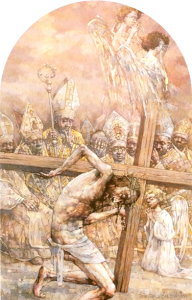
Jesus of course is our Good Shepherd (J 10.11). He laid down his life for us His sheep and has been raised to new life. Jesus from on high still cares for us. Still, the Church needs faithful shepherds and God does provide (Eph 4.11).
The Apostle Paul advises Timothy in his ministry as a shepherd of the Christian community:
Till I come, attend to the public reading of scripture, to preaching, to teaching. Do not neglect the gift you have, which was given you by prophetic utterance when the elders laid their hands upon you. Practice these duties, devote yourself to them, so that all may see your progress. Take heed to yourself and to your teaching; hold to that, for by so doing you will save both yourself and your hearers. (1 Tim 4:13-16)
The instruction of the Apostle Paul to Timothy is an instruction to all who fulfil a similar role. They are to keep a watch on their teaching because the salvation of the people as well as their own salvation depend on it.
But how will shepherds be judged if they neglect to perform their role or even worse teach with care? To whom much is given, much will be expected, and the Apostle James explains the consequence of this:
Let not many of you become teachers, my brethren, for you know that we who teach shall be judged with greater strictness. For we all make many mistakes, and if any one makes no mistakes in what he says he is a perfect man, able to bridle the whole body also. If we put bits into the mouths of horses that they may obey us, we guide their whole bodies. Look at the ships also; though they are so great and are driven by strong winds, they are guided by a very small rudder wherever the will of the pilot directs. So the tongue is a little member and boasts of great things. How great a forest is set ablaze by a small fire!
Indeed, because of their gift, teachers will be judged with greater strictness in how they discharge their charism. The same standard is not applied to all. The lives of shepherds and their teaching will come under greater scrutiny. Pray for them!
The special presence of Christ
Some words of the Lord Jesus are incredibly mysterious. “It is to your advantage that I go away,” Jesus once said to the apostles, “for if I do not go away, the Counsellor will not come to you; but if I go, I will send him to you.” (cf. Jn 16:7). Why was the departure of the Lord Jesus necessary for the coming of the Holy Spirit?
Well, the Church Fathers carefully noticed that when the Lord Jesus was with people, you could see Him, you could even touch Him, ask Him something . . . but it was always a situation that Jesus was “here”, and I, you, he, she, we were “there”. This is not the case now. When Jesus ascended to the Father after His resurrection, He sent the Holy Spirit, so that now in our present time He sends Him constantly into our hearts – there is the possibility of an incomparably deeper unity with Him. Namely, the unity that the Apostle John describes as: We abide in him, and he in us” (cf. 1 J 3:24).
Thanks to the presence of the Holy Spirit in the Church, we have access to the authentic teachings of the Lord Jesus. Because the resurrected Jesus fulfils His promise that He will give the shepherds of the Church the Holy Spirit, and ” he will teach you all things, and bring to your remembrance all that I have said to you ” (Jn 14:26). This is why the words of the Lord Jesus will always be true: ” He who hears you hears me, and he who rejects you rejects me” (Lk 10:16), and: “I will give you the keys of the kingdom of heaven, and whatever you bind on earth shall be bound in heaven, and whatever you loose on earth shall be loosed in heaven” (Matthew 16:19).
The presence of the Holy Spirit in the Church means that thanks to the ministry of the shepherds, every believer has direct access to the Lord Jesus. The source giver of all the sacraments is Jesus Christ Himself. In the sense that, for example, in the sacrament of penance, it is He Himself who forgives our sins and bestows grace (“If you forgive the sins of any, they are forgiven; if you retain the sins of any, they are retained” – J 20:23).
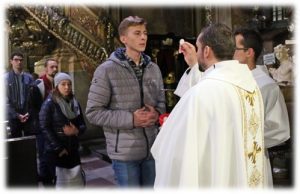
What’s more, in the Eucharist, He really makes Himself present in His love in which He gave His life for us on the cross. On the other hand, in Holy Communion we unite ourselves with Him so deeply that we are allowed to say: “it is no longer I who live, but Christ who lives in me ” (cf. Gal 2:20).
22/01/2023