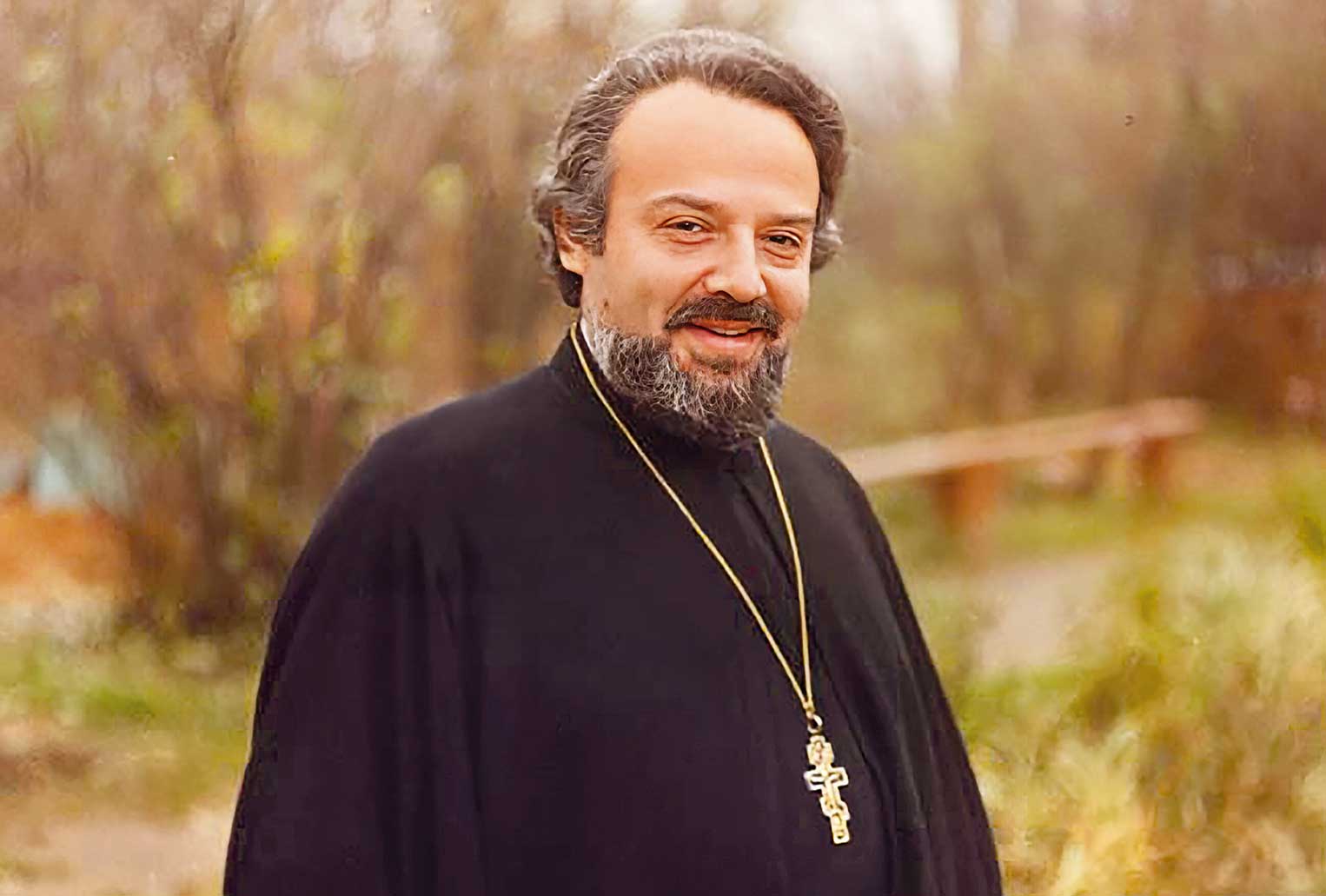
Father Aleksander-Mien (Отец Александр Мень), who evangelized in Russia
“No one has greater love than this: to lay down one’s life for one’s friends.” (John 15:13)
In the final decades of Soviet communism, when the false certainties of an atheistic regime were beginning to collapse and countless souls were searching for light in the darkness, a humble Russian priest gave everything to lead others to Christ. That priest was Fr Aleksander Men — pastor, evangeliser, apologist, writer, and, in the end, a witness sealed in blood.
Beginnings
Aleksander, known in childhood as Olek, was born in Moscow in 1935. His father was Jewish and, despite a strong knowledge of the Torah, the Prophets, and the Writings, was an atheist. His mother, also Jewish, was deeply drawn to Christianity. His birth came at a time of severe trial, when nearly all churches in Russia had been closed.
Some Orthodox clergy fled abroad; others were executed or sent to labour camps. Of those who remained, some submitted to the communist authorities, while others continued their ministry in secret. It was into this hidden, “catacomb” Church that Olek’s mother entered. Together with her sister Viera and six-month-old Olek, she travelled to Zagorsk to meet Fr Seraphim Batiukov. There, in a small private house, all three were quietly baptised. Later, they would often attend clandestine services there.
A Calling Takes Shape
Fearing a Nazi invasion, Stalin somewhat eased the persecution of the Orthodox Church. Some priests were released from prison, and certain churches and seminaries in Moscow and Leningrad were reopened. By the end of the war, Olek was ten years old. When Moscow celebrated the 800th anniversary of its founding, he was twelve. That day marked a decisive turning point.
He later recalled:
“It was a warm evening… Everyone went out into the street. It was dark, but lights burned all around, and from behind a stone bridge there suddenly emerged a huge head of Stalin, which soared into the black sky, hanging in the air. Lights were shone on it, and I, looking at this head of the Antichrist, thought that I absolutely must become a priest, to somehow stand up to such things.”
As a teenager, he even tried to enter seminary, but was told to return when he was older. In 1953, after finishing school, Aleksander enrolled at the Moscow Fur Institute. During his studies, he met Natalia Grigorenko, who would become his wife in 1956. Their marriage was blessed with a daughter and a son.
In his final year, just before graduation, the authorities discovered his ties to the Church. He was expelled from the institute “because of his religious convictions”.
In the Service of Christ
Aleksander recognised in this expulsion not defeat, but providence. In the Orthodox tradition, married men may be ordained to the priesthood, and he now gave himself fully to that path. He was first ordained a deacon and assigned to the parish in Akulovo, where he served for two years. After completing studies by correspondence at the Leningrad seminary, he was ordained priest on 1 September 1960 and sent to serve in Alabino, near Moscow.
Fr Aleksander was, above all, a man of prayer and sacrificial pastoral charity. He understood the priesthood as a participation in Christ’s saving mission. He lived in deep union with God and brought Christ to others through preaching, confession, and the Eucharist.
He often taught that:
“Christianity is a religion of the future, toward which humanity has matured over millennia. It is not primarily a new doctrine, morality, or ethics, but Christ Himself.”
For him, the heart of Christianity was not an abstract system but the living Person of Jesus Christ — true God and true Man — who entered history, conquered darkness, and offered His life for the salvation of the world. The task of the missionary, he believed, was to help souls encounter Christ above all in Sacred Scripture, especially the Gospel.
He tirelessly proclaimed that Christ is not absent from the world, but present and active. The Resurrection, he said, is not a symbol, but a real and mysterious transformation that shakes the world. The Risen Lord can be encountered in prayer, in repentance, in the Eucharist, and in His word — if only we open our hearts to Him.
Reflecting on the Book of Ecclesiastes, Fr Aleksander wrote with striking spiritual clarity:
“It takes but a moment for a person to calmly look at their life and see that it has no meaning. That only when we rise above what is experiential do we discover wings. And ourselves… We can experience God’s love through everything: through the clouds overhead, through the eyes of a beloved person, through the stars in the sky… God is only waiting for you to recognise Him… He always speaks within us, but His voice is very quiet… God utters His word in silence.”
A Priest Under Suspicion
After Khrushchev’s fall in 1964, the long stagnation of the Brezhnev years began. Public faith in communist ideology was weakening, and more people started searching for truth and meaning. Religion was no longer dismissed quite so easily. Many began to wonder whether it might hold the answer to the deepest questions of the human heart.
Fr Aleksander’s flock grew quickly. People travelled to him from across the Soviet Union. He offered not cold instruction, but warmth, attentiveness, and personal care. He avoided harshness and preferred dialogue, inviting souls to seek truth sincerely and courageously.
Yet this fruitfulness brought opposition. The parish priest under whom he served became envious and reported him to the KGB. In 1964, Fr Aleksander endured the first of many house searches, along with interrogation at the notorious Lubyanka headquarters in Moscow.
For the next year he ministered under constant suspicion and surveillance. He lived with his wife and two young children in a single room in a village house, deprived of basic comforts. Yet he continued to pray, study, write, and serve. In 1965, he completed further studies by correspondence at the Moscow Theological Academy.
A New Parish, A Growing Mission
In 1970, when a place opened for a second priest in Novaya Ves, some 40 kilometres from Moscow, Fr Aleksander moved there with his family from Tarasovka. They settled in Semkhoz, near Zagorsk (now Sergiyev Posad), and he travelled by train to the parish.
Soon word spread throughout the USSR: here was a shepherd who truly cared for souls. For the next twenty years, Semkhoz and Novaya Ves became places of grace and renewal for thousands who were awakening to faith and longing for God.
Fr Aleksander believed that the renewal of the Church must come through a return to the spirit of the early Christian communities: shared prayer, shared Eucharistic life, study of the word of God, and concrete mutual support. To strengthen the spiritual life of the faithful, he began organising small groups in parishioners’ homes — something almost unheard of in Russian Orthodoxy at the time. There they studied the faith and the history of the Church.
He also formed catechumen groups for adults preparing for baptism. Many were intellectuals; many were Jews. They came without fear, knowing that Fr Aleksander himself was of Jewish origin and that in him they would find not suspicion, but charity and understanding.
The Men household became a place of generous hospitality. Prominent intellectuals and artists visited, including Aleksandr Solzhenitsyn, Fazil Iskander, and Aleksandr Galich, among others. Fr Aleksander was simple and practical as well as learned: if his wife was away, he cooked for himself and willingly took up ordinary household tasks.
The parish church — the wooden Church of the Presentation of the Lord — became home to a remarkable circle of believers, including musicians, poets, catechists, scholars, writers, and artists. Because so many members of the intelligentsia came to him, the parish became widely known as the “parish of the intelligentsia”.
From this community emerged several notable Orthodox priests, among them Georgii Chistyakov, Vladimir Lapshin, and Aleksander Borisov, who after Fr Aleksander’s death would continue caring for his many spiritual children.
It is striking that for most of his life Fr Aleksander held only secondary positions in parish life. In Novaya Ves he became parish priest only in the final year of his service there.
Opposition for His Openness to Catholics
Under communism, both state and ecclesiastical authorities often preferred a Church that was quiet, nominal, and manageable. Genuine evangelisation, serious catechesis, and living faith were viewed as dangerous.
In 1974, KGB chief Yuri Andropov submitted a report to the Central Committee warning of a religious group allegedly sympathetic to Western — that is, Catholic — Christianity, and naming Fr Aleksander Men as its leader.
This suspicion arose in part from his friendship with Fr Stanisław Dobrowolski, a Catholic priest whom he visited and to whom he sent some of his parishioners, especially baptised Moscow Jews, for retreats and spiritual guidance. Fr Stanisław heard confessions, distributed Holy Communion, and offered catechesis. In this way, the two priests helped foster a serious and deeply formed Christian intelligentsia within Russian religious life.
Fr Aleksander’s writings also profoundly influenced the future Catholic Archbishop of Riga, Zbigniew Stankiewicz. Having lost his faith at fourteen and wandered through Buddhism, yoga, and Eastern spiritualities, he later testified that reading Fr Aleksander’s works brought him back not only to Christianity, but eventually to the Catholic priesthood and episcopate.
Yet ecumenical openness was viewed with hostility by many, including not only the secret police but also numerous Orthodox clergy, some of whom regarded ecumenism as betrayal. In 1985, a criminal case was fabricated against Fr Aleksander, and only the intervention of Metropolitan Juvenaly spared him imprisonment.
In the spring of 1986, the newspaper Trud launched a public attack on him, accusing him of creating an “anti-Soviet underground” through “illegal religious events” and of producing religious slide presentations for distribution among the faithful. Those presentations, prepared with pastoral zeal and creativity, still bear witness to his desire to teach the faith by every licit means available.
A Voice for a Hungry Nation
Relief came only with perestroika. As restrictions eased between 1985 and 1991, Fr Aleksander was finally able to preach publicly. His first invitation came from the Institute of Steel and Alloys. On 11 May 1988, to the organisers’ astonishment, the large lecture hall filled to overflowing, even though there had been no publicity.
The response revealed a profound spiritual hunger. Scientific institutes, schools, cultural centres, factories, and workplaces all invited him to speak. In just two years, in addition to his parish ministry, he delivered around 200 lectures, conferences, and public meetings, almost always to packed audiences.
After 1988, media interest in him increased significantly, and one of the main television channels broadcast one of his lectures. Nine more were recorded in advance.
“Be Faithful Unto Death”
(Revelation 2:10)
“Lately around Father Aleksander there was more and more hostility,” recalled Aliona, daughter of the poet Aleksandr Galich.
On the morning of 9 September 1990, Fr Aleksander set out as usual through a small grove on his way to the station, intending to catch the train for the Divine Liturgy. There, someone struck him from behind with an axe, delivering a fatal blow to the head.
Bleeding heavily, the priest somehow rose and staggered back towards home. He collapsed near the gate. Because his wife’s eyesight was poor, she did not at first recognise him, thinking he was a drunken man lying there. When she saw the blood, she called an ambulance, but it was too late. The evidence relating to the murder later disappeared in mysterious circumstances, and the crime remains unsolved.
At his funeral, many of the faithful kissed his hand and were astonished to find it still warm and soft. Testimonies also began to circulate of graces and healings received through his intercession, both during his life and after his death. In Semkhoz, where he lived and died, a cross was raised, and beside it a small church dedicated to Saint Sergius of Radonezh was built.
His Legacy Lives On
After his murder, both hidden and open enemies tried to erase his legacy. His home was searched. Books, slides, and recordings were confiscated. The nine recorded lectures that had not yet been broadcast vanished. For years, Orthodox parishes were discouraged or forbidden from distributing his works.
Yet darkness did not prevail.
His spiritual children persevered. Piece by piece, they recovered and preserved his writings. In the 1990s, his books were published in millions of copies. His influence only grew.
The Russian Bible Society, founded in 1990 with his active participation, continues its work. So too do the Public Orthodox University he helped establish, the magazine World of the Bible, and the Mercy Group at the Russian Children’s Oncological Hospital, later named after him. Metropolitan Juvenaly also established the tradition of annual Men Readings in his memory.
Among his best-known works is The Son of Man, first published in Brussels in 1969 under the pseudonym Andrei Bogolyubov. It became a bestseller. His monumental seven-volume History of Religion: In Search of the Way, Truth and Life was published posthumously. Other important works, many originally published under the pseudonym Emanuel Svetlov, include:
- Magic and Monotheism
- Messengers of the Kingdom of God
- How to Read the Bible
- Sacrament, Word, Image
- Where Did It All Come From?
- A Practical Guide to Prayer
- Magic, Occultism, Christianity
A Final Witness
In a letter from July 1978, Fr Aleksander wrote words that still speak powerfully today:
“In Hebrew the word faith (*emuna*) comes from a root closely related to the idea of fidelity… Its opposite is not unbelief, but infidelity… Faithfulness to God is at the same time faithfulness to people, faithfulness to oneself… The enemy is the loss of that faithfulness under the influence of the storms that rage over and around us.”
That insight is as timely now as it was then. In a world still shaken by confusion, compromise, and fear, Fr Aleksander Men reminds us that fidelity is possible, holiness is possible, and courageous witness is possible.
He stood against lies not by violence, but by truth.
He answered hatred not with bitterness, but with Christ.
He lived as a shepherd.
He died as a witness.
And so his life continues to encourage all who long to remain faithful in difficult times: the light of Christ cannot be extinguished.
Sources: N. Kandudina, Father Aleksander Mien – Pastor, Theologian, Missionary; www.alexandermen.ru; A. Mien, Dictionary of Biblical Studies; Ya. Krotov, Stanislav Dobrowolski; P. Przeciszewski, Conference on persecuted ministers of the intelligentsia in USSR, www.ekai.pl; Conference in memory of Father Aleksander Men, YouTube.
June 29, 2026