Saint John Paul II, during a meeting with representatives of scientific life, pointed to the fundamental cause of contemporary chaos and confusion: “One of the great dramas of man is expressed in the gap between reason and faith.”
A Fatal Rift
Saint John Paul II, speaking on June 4, 1997 on the duty of consecrated persons, stated bluntly: “We live in a time of spiritual chaos, disorder and confusion, in which various liberal and secular tendencies come to the fore, God is often openly deleted from social life, faith is reduced to a purely private sphere, and harmful relativism is introduced into human moral conduct. Religious indifference is spreading.”
Two years later, during his next pilgrimage to his homeland, Saint John Paul II, during a meeting in Toruń with representatives of Polish scientific life, pointed to the fundamental cause of this contemporary chaos and confusion: “One of the great dramas of man is expressed in the gap between reason and faith. It has many causes. Especially from the age of the Enlightenment, exaggerated and one-sided rationalism led to the radicalization of attitudes in the natural sciences and in philosophy. The resulting split between faith and reason has done irreparable damage not only to religion but also to culture.”
On this issue, Saint John Paul II returned in his last book entitled Memory and Identity (2005), when he stated: “The rejection of Christ, and in particular His paschal mystery – the cross and resurrection – appeared on the horizon of European thought at the turn of the seventeenth and eighteenth centuries. It was the period of enlightenment […]. Whatever form it took, the Enlightenment opposed what Europe had become as a result of evangelisation.
Fundamentally anti-Christian, because it was hostile to Revelation, the thought of the Enlightenment held that a rational person cannot be a believer. Another revolutionary shock two centuries earlier, the Protestant Reformation, held that the believer should not appeal to reason. Martin Luther in his writings repeatedly called reason “a whore” (in the original there was another, more vulgar word), believing that one of the proofs that “the Roman Church became the servant of the Antichrist” and that Saint Thomas Aquinas was the philosophy of the pagan philosopher Aristotle for the purposes of Catholic theology.
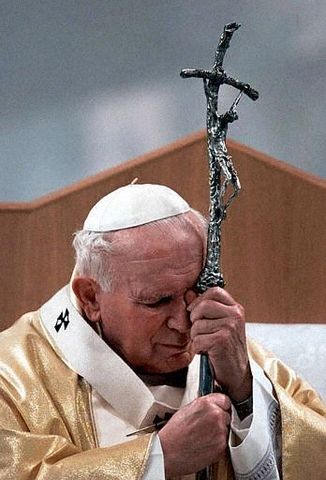
In his wonderful encyclical Fides et Ratio (1998), Saint John Paul II emphasized that this rupture of the link between faith and reason, dating from modern times in European culture, brought a sinister consequence in the form of “the temptation of a quasi-divine power over nature and even over the human being” (FR 46). Giving in to this temptation – as Saint John Paul II taught – led straight to nihilism: “Its adherents claim that the search is an end in itself, without any hope or possibility of ever attaining the goal of truth. In the nihilist interpretation, life is no more than an occasion for sensations and experiences in which the ephemeral has pride of place. Nihilism is at the root of the widespread mentality which claims that a definitive commitment should no longer be made, because everything is fleeting and provisional.” (FR 46).
This nihilism on the philosophical and anthropological planes resulted and still results in various forms of relativism. Saint John Paul II in Fides et ratio as a “form of modernism” denounces so-called “historicism” that “what is true in one age may not be true in another” and thus quite wrongly equates “relevance with truth” (FR 87).
The crisis of truth
Speaking on May 15, 1982, in the walls of one of the oldest European universities, in Coimbra, Portugal, Saint John Paul II, referring to the loss through “modern culture’’ of the “principle animating and unifying society”, stated at the same time that “this loss of vital power and influence seems to be grounded in a crisis of truth. The sense of truth has been seriously shaken in every respect. Careful observation shows that it is ultimately a metaphysical crisis.
The frontal attack on truth taking place in the modern world is primarily relativism, raised to the rank of a virtue. We read in the encyclical Fides et Ratio: “A legitimate plurality of positions has yielded to an undifferentiated pluralism, based upon the assumption that all positions are equally valid, which is one of today’s most widespread symptoms of the lack of confidence in truth. [. . .] On this understanding, everything is reduced to opinion” (FR 5).
Saint John Paul II noticed the denial of man’s fundamental vocation, defined as “steps towards a truth which transcends them” (FR 5), also in the Church itself. In our times, it is often heard, even from the mouths of prominent (highly ranked) people of the Church, that there are “the truth of doctrines” and “pastoral truth”, and that the former as being “rigorous” is inaccessible to ordinary Catholics and therefore for “pastoral reasons” one should turn a blind eye to sin (e.g. living in a non-sacramental relationship) and allow access to the sacraments (Eucharist) for supposedly higher purposes (family cohesion, well-being of children who might feel uncomfortable with the fact that parents do not receive Holy Communion, etc.).
30 years ago, this approach was already strongly rejected by Saint John Paul II, who in his great encyclical Veritatis splendor (1993) denounced as inconsistent the teaching of concept of the “double status of moral truth”. The Pope defined this notion as the belief that “beyond the doctrinal and abstract level, one would have to acknowledge the priority of a certain more concrete existential consideration. [. . .] On this basis, an attempt is made to legitimize so-called “pastoral” solutions contrary to the teaching of the Magisterium” (VS 56).
A Catholic – as taught by Saint John Paul II in Veritatis splendor – cannot share the view that “by virtue of a primordial option for charity, that an individual could continue to be morally good, persevere in God’s grace and attain salvation, even if certain of his specific kinds of behaviour were deliberately and gravely contrary to God’s commandments as set forth by the Church” (VS 68).
In 1993, the Holy Father already noticed a problem that in our times severely affects many people of the Church. In Veritatis Splendor, the Pope warned that “a new situation has come about within the Christian community itself, which has experienced the spread of numerous doubts and objections of a human and psychological, social and cultural, religious and even properly theological nature, with regard to the Church’s moral teachings. It is no longer a matter of limited and occasional dissent, but of an overall and systematic calling into question of traditional moral doctrine, on the basis of certain anthropological and ethical presuppositions” (VS 4).
The recently deceased Professor Stanisław Grygiel, an outstanding Polish philosopher, student and friend of Saint John Paul II, in an interview published in 2020, conducted by Dr. Maria Zboralska, entitled To live means to philosophise, almost 30 years after this papal analysis, he pointed out that many people of the Church, “subjecting themselves to democracies defined by numbers, begin to replace theology – with sociology, statistics, psychology, and eventually they will replace it with psychiatry.” The words of a friend of SaintJohn Paul II uttered three years before his death: “I am afraid of people losing trust in shepherds, many of whom put themselves before Christ and try to show Him the way to who knows where. […] They form opinions about Christ and live according to them, and they bend the Gospel to them. Instead of bearing witness to the Truth, instead of entrusting themselves to it regardless of the consequences, they pursue a policy that allows them to arrange a comfortable life in this world”.