“It is an illusion to think that faith, tied to weak reasoning, might be more penetrating; on the contrary, faith then runs the grave risk of withering into myth or superstition” (Saint John Paul II, Fides et Ratio, 48).
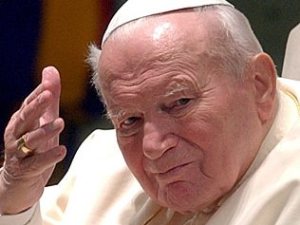
Saint John Paul II during the 23rd Eucharistic Congress in Bologna, 28 September 1997.
2023 marked the anniversary of the publication of very important documents of the Magisterium of the Church from the time of the pontificate of Saint John Paul II: the 30th anniversary of the publication of the encyclical Veritatis splendour (1993) and the 25th anniversary of the encyclical Fides et Ratio (1998). It is worth noting that the teaching contained in these documents was continued by Pope Benedict XVI, and today, unfortunately, it is either widely contested or passed over in silence – even in some circles that officially call themselves “Catholic”.
Faith is not just emotions.
One should refer to these great encyclicals of Saint John Paul II, because they contain valuable tips that would help avoid many problems affecting the Church at the beginning of the 21st century. In this context, it is necessary to point out the increasingly frequent association of faith with the sphere of emotions. Many people of good will take well-being as the only measure of life in sanctifying grace. In doing so, they unknowingly make the mistake of Martin Luther, who believed that inner peace (“certainty of being saved”) was the only test of the vitality of faith. And yet the history of the Church shows many examples of saints who for a long time experienced not so much of the “dark night” as of the many “dark years” of faith, consisting in experiencing extreme mental discomfort, feeling (illusory) that God is far away. It is enough to mention in this context the figure of Saint Mother Teresa of Calcutta.
The Saints teach that this mental discomfort should be overcome by will, worked out through constant prayer and strengthened by the sacraments and the power of reason focused on God. Here the teaching of St. John Paul II, who in the encyclical Fides et Ratio reminded us that “It is an illusion to think that faith, tied to weak reasoning, might be more penetrating; on the contrary, faith then runs the grave risk of withering into myth or superstition. By the same token, reason which is unrelated to an adult faith is not prompted to turn its gaze to the newness and radicality of being.” (FR 48).
In a similar way, Card. Joseph Ratzinger wrote about faith and reason. On April 1, 2005, shortly before his accession to the throne of Peter, he said that “Christianity must always remember that it is the religion of the Logos. It is faith in the Creator Spiritus, in the creative Spirit from whom all reality comes”. As Benedict XVI, he developed this idea a year later during a famous address in Regensburg. The concept of God, who is “Love and the highest Reason”, is something that fundamentally distinguishes Christianity (and thus European culture) from the voluntarist vision of God (emphasizing above all the almighty will of Allah, who could even order his followers to worship idols and this call should be heeded) prevailing in Islam. Meanwhile, as the Pope reminded us in this address, the Christian vision states that “acting contrary to the Logos is something contrary to the essence of God.”
In his teaching, Pope Benedict XVI repeatedly emphasized the need to maintain a benevolent harmony between faith and reason. In a speech delivered on September 17, 2010, in London’s Westminster Hall, he recalled that religion plays a “corrective role” for reason by “enlightening it on the way to discovering objective moral principles.” In the same speech, Benedict XVI also pointed out that “we pay too little attention to the purifying and ordering role of reason within religion.”
Sound theology needs sound philosophy.
In the encyclical Fides et Ratio, Saint John Paul II noticed the spread of “an attitude of deep distrust towards reason, visible in the latest forms of many currents in philosophical reflection”. Observing in our times the expansion of ideologies disguised as science (a typical case: the so-called gender studies), and succumbing not only to reason, but even common sense can be said not so much to distrust reason as to have contempt for it.
Trust in the cognitive abilities of the human mind, in its ability to know the truth, characterised the philosophy of the classical period (with Aristotle at the forefront), whose achievements were adapted to the teaching of the Gospel by the great Christian philosophers and theologians with Saint Thomas Aquinas at the head. This is how the metaphysical philosophy was born, affirming the existence of being (for ‘being’ read: works of creation), exploring its essence and knowing that the truth does not lie in the middle, but is where there is a place in the entire structure of being.
On the urgent need to return to such a metaphysical philosophy, Saint John Paul II wrote in the encyclical Fides et Ratio: “A radically phenomenalist or relativist philosophy would be ill-adapted to help in the deeper exploration of the riches found in the word of God [. . .] the need for a philosophy of genuinely metaphysical range, capable, that is, of transcending empirical data in order to attain something absolute, ultimate and foundational in its search for truth” (FR 82,83).
As a reliable guide on this path, Saint John Paul II pointed to Saint Thomas Aquinas, in Fides et Ratio; he emphasized that “the Magisterium’s intention has always been to show how Saint Thomas is an authentic model for all who seek the truth. In his thinking, the demands of reason and the power of faith found the most elevated synthesis ever attained by human thought” (FR 78). The author of Summa Theologica – as we read in Fides et ratio – should be treated in seminaries and in theology department as “a master of thought and a model of the right way to do theology” (FR 43).
Saint John Paul II gave a clear path: first, a healthy philosophy (metaphysical like Aquinas). Only on this can a sound theology be based. This, in turn, is a condition for proper priestly formation. Properly formed priests, in turn, are able to carry out pastoral work well, based on the truth that faith will not grow on a weak mind.
This papal teaching is worth putting side by side with the observations of Cardinal Joseph Ratzinger, who in May 1989, as the prefect of the Congregation for the Doctrine of the Faith, during an international theological conference, listed the main symptoms of the crisis of theology practiced in nominally Catholic theology faculties of many universities in the Western world. In this context, he spoke of the need for a renewal of Catholic identity most urgently: the doctrine of creation, Christology and the presence of faith in the eternal life in the Church’s preaching. The crisis observed in these areas – emphasized Cardinal Ratzinger – has a common background in the “loss of metaphysics” and the common fatal consequence is “the abolition of the cross, and thus, of course, also the deprivation of the resurrection, the annulment of the meaning of the whole Paschal mystery.” This means that “the two main centres of gravity of the faith in Christ of the authors of the New Testament and of the Church of all times have been abolished or at least deprived of their function: the metaphysical sonship of God and the paschal mystery.”
Cultural heritage must be protected.
Both Saint John Paul II and Benedict XVI unequivocally rejected the ideology of multiculturalism, which posits that “all cultures are equal.” This perspective implies a moral equivalence among varied cultural traditions, often to the detriment of those rooted in the West, particularly the European and Latin heritages shaped by Greco-Roman foundations and the spirit of the Gospel.
In contemporary discourse, this relativistic viewpoint finds its most extreme expression in the phenomena of “cancel culture” and “woke” ideology, both of which have permeated public life, especially within universities and urban centres across the West. The implications of such trends raise urgent questions about cultural identity and the value of our historical legacy, necessitating a critical examination of the challenges posed by these movements to traditional beliefs and societal cohesion. In Fides et Ratio, St. John Paul II, however, reminded that “ in engaging great cultures for the first time, the Church cannot abandon what she has gained from her inculturation in the world of Greco-Latin thought. To reject this heritage would be to deny the providential plan of God who guides his Church down the paths of time and history” (FR 72). In the same encyclical, the Holy Father saw “ a mistaken notion of cultural pluralism “ that “deny the universal value of the Church’s philosophical heritage” (FR 69).
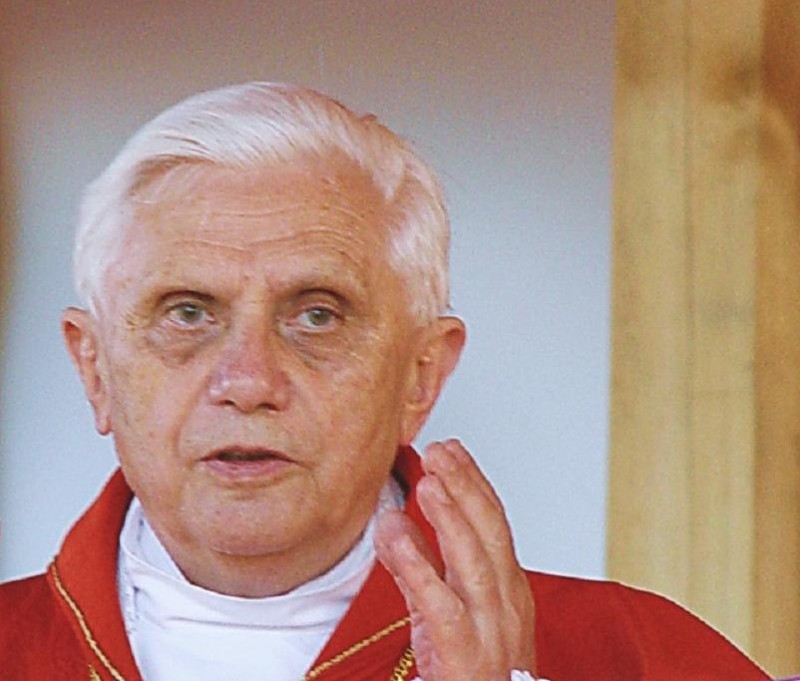
Benedict XVI continued the teaching undertaken by John Paul II in the encyclicals Veritatis splendor and Fides et ratio.
For the first example of “fruitful dialogue” between Christianity and non-Christian culture, St. John Paul II considered the reception of classical Greek philosophy by the Fathers of the Church, which “offered new ways of proclaiming and understanding the God of Jesus Christ” (FR 36). Thanks to this encounter classical philosophy was prepared “to purify human notions of God of mythological elements”, the fathers, and thanks to them the whole Church, “ fully welcomed reason which was open to the absolute, and they infused it with the richness drawn from Revelation”. In this way, a “purified and rightly tuned, therefore, reason could rise to the higher planes of thought, providing a solid foundation for the perception of being, of the transcendent and of the absolute” (PR 37,41).
Benedict XVI referred analogously to the ideology of multiculturalism. In his encyclical Caritas in veritate published in 2009, among the many symptoms of the crisis affecting contemporary Western civilization, the Pope pointed to the spread of the phenomenon of “eclecticism and cultural levelling”. Benedict XVI criticized the “cultural eclecticism that is often assumed uncritically “, according to which “cultures are simply placed alongside one another and viewed as substantially equivalent and interchangeable” (CV 26). Cultural relativism understood in this way, as emphasized by Benedict XVI, leads to the separation of entire “cultural groups”, and thus the way to “authentic dialogue” and “true integration” is closed (CV 26).
The condition for real intercultural dialogue is not the relativism that “every culture has its own truth”, but the opposite: the recognition that there is an objective, culturally unconditional truth. Joseph Ratzinger spoke about this in 2000 as prefect of the Congregation for the Doctrine of the Faith, emphasizing that “Europe, if it is to survive, needs a new – probably critical and humble – self-acceptance. Cultural pluralism, praised and supported with great enthusiasm, often consists in rejecting with contempt what is one’s own, in escaping from one’s own values. But, after all, cultural pluralism cannot stand without the common preservation of certain fixed values, without points of reference derived from its own values. It cannot stand without respecting what is sacred”.