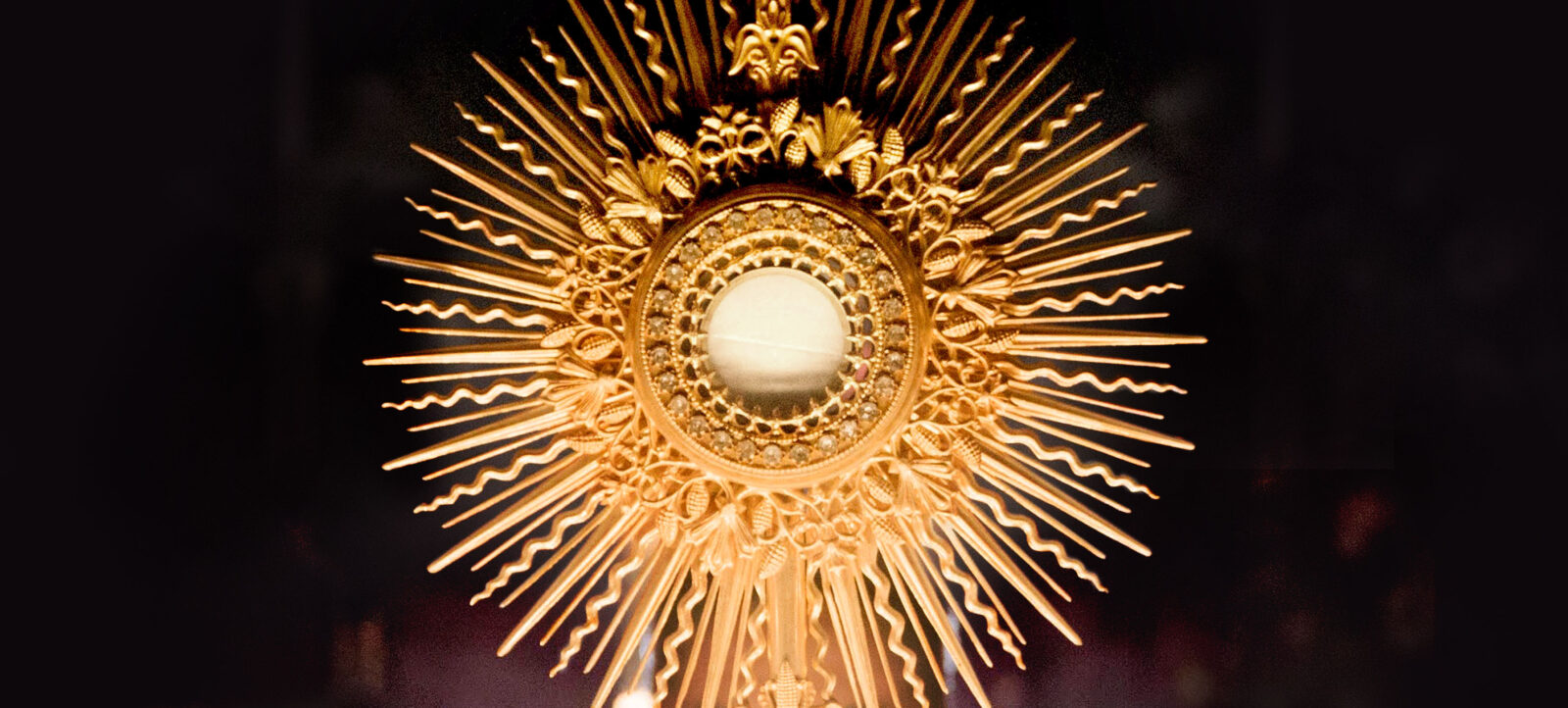
 For the body to gain vitamin D, all you have to do is sit in the sun. The rest is just a matter of time, in which the sun’s rays need to do their work. But the soul can also gain vitamin D! It is enough for it to be in the rays of the Eucharist. In Christian spirituality we find a very beautiful and at the same time theologically deep analogy of the Eucharist as the sun.
The Eternal Father Himself uses this comparison when addressing St. Catherine Sieneńska: “My Son’s Eucharistic Body is the sun, because it is one with Me – the true Sun. Just as in the sun it is impossible to separate heat from light or light from its colour – so also My perfect unity with the Eucharistic Body of the Son cannot be separated. This true and indivisible Sun illuminates the world and warms all those who want to warm themselves in its rays (…). I tell you that this Body is the indivisible sun. Thus, you cannot receive the Body of the Son of God without simultaneously receiving His Blood, neither Body and Blood without the Soul of the Word, nor Body without my eternal Divinity, for one is inseparable from the other (…). So, in this sweet sacrament, in the form of white bread, you receive the Divinity itself.
Over the centuries, there have been many miracles involving the transformation of the Host into a solar sphere. For example, in 878, in the hands of the Patriarch of Constantinople, Saint Ignacius the Host “shone like lightning”. Something similar happened during the Eucharistic celebration of Saint Yves in the 11th century. Six centuries later, when Saint Michael (8th-century saint) held up the white bread at the moment of consecration, the faithful saw “a crown of splendid rays that came out of the Host, shining like the sun. This light spilled over the priest and the altar and remained so until communion.
Mother Yvonne Aimée, a French nun whose cause is with Rome, had extraordinary experiences of this type many times. Just a few months ago, her confessor died at the age of ninety-six. He was an eyewitness to the nun’s mysterious search for profaned hosts. The priest had a photograph of a small, luminous Host that had been pierced by the thieves.
The comparison of the Eucharist to the sun is rooted in the Bible. In Zechariah’s canticle, Jesus is called “the sun that rises from on high to give its light to those who live in darkness and the shadow of death” (Lk 1:78-79).
Saul, going to Damascus with the intention of persecuting the Christians there, saw a light brighter than the sun from heaven. This mysterious light presents itself to him: “I am Jesus whom you are persecuting” (Acts 26:13, 15).
In the Apocalypse of Saint John describes the Heavenly Jerusalem, where the sun and the moon do not needed to shine, because the glory of God illuminates it, and its lamp is the Lamb (Rev 21:2).
The image of the sun fits perfectly into the Eucharist, because the Host is Jesus, the Lamb of God and the Rising Sun. This comparison is helped by the fact that for many centuries the Host has been shaped like a white, sunny shield. It is known how important the sun is in nature . . . The Eucharistic Sun also plays an irreplaceable role for the spiritual life: it gives the soul radiance, enlightens the conscience, warms the heart, enables the whole person to grow towards God.
The Book of Malachi mentions one more important function: “ But for you who fear my name the Sun of righteousness shall rise, with healing in its wings” (Malachi 4:2).
Thus, the rays of the “Sun of Righteousness” bring with them, above all, healing: soul, body, heart.
Jesus makes this clear to Saint Gertrude: “Here, in the Eucharist, in the generous goodness of my Heart, I heal the wounds of every human being: I lift the sinner’s spirit, I enrich spiritual poverty with the gift of virtues, and I console everyone in their affliction.”
From the depth of his faith in the healing power of the Eucharist, Saint John Chrysostom spoke to the faithful in this way: “When approaching the Eucharist, let each one approach their illness, because here we can also receive healing of the body.”
There are so many testimonies about miraculous healings in the rays of the Eucharist that each successive miracle does not really make any deeper an impression on us. Sometimes people far from the Church are more surprised, such as Voltaire, for example, who put all his intelligence into the fight against Christianity during the French Enlightenment. In a letter to a lady, he confesses – not without emotion and even emotion – that he was an eyewitness to a miracle that took place on May 31, 1725 in the parish of St. Margaret. A resident of Paris, Anna Lafosse, had been suffering from blood loss for twenty years. Due to exhaustion, she hardly left her bed.
On the feast of Corpus Christi, she decided to beg for healing, but when the procession with the Blessed Sacrament approached her street, she was overcome with doubts and fear. Just at that moment, a friend who was a Protestant and did not believe in the real presence of Christ in the Host appeared where she was. Seeing the suffering and fears of the sick woman, she began to encourage her to trust completely in the Risen One, whose power in heaven is not less than that with which He healed on earth. In this encouragement Anna read the longed-for sign from heaven. So she ordered to be carried in an armchair to the street where the procession was to pass.
When the monstrance was closest, she threw herself on her knees and began to cry out: “Lord, if you will, you can heal me; I believe that in the Host you are the same who entered Jerusalem: forgive me my sins and I will be healed!”
People tried to get her out of the way thinking she was mentally unstable. But she followed the monstrance, first on her knees and then walking. She was gaining more and more strength, although she had lost a lot of blood along the way. The procession was followed by a service during which the woman was completely healed. After recognizing the supernatural nature of the miracle, the bishop ordered that the story be written down and placed in the church. According to archival records, between 1725 and 1789, over seventy miraculous healings took place during the Corpus Christi procession.
What about Voltaire? What about his faith? Perhaps not something miraculous, but puzzling, in the context of his atheistic writing, is the confession: “This event gave me a thin tinsel of piety, me who serves God as much as the devil.”
It is amazing how many miraculous healings in the Sun of the Eucharist are taking place nowadays as part of the charismatic renewal of the Church and in all kinds of oases of Eucharistic worship. Sister Briege McKenna, an Irish nun who has been ministering to priests around the world for more than twenty-five years, has written a book that provides concrete examples of the healing power of Christ in the Eucharist.
“Once”, sister writes, “after the liturgy I was praying with Fr. Kevin for healing. Among those gathered was a child with his parents who suffered from a severe brain disease. During the elevation of the Blessed Sacrament, the child raised his head and stretched out his hands towards the Host. The next day the disease completely disappeared. At the same service there was a girl who was a Mormon. I spoke about the real Presence of the Risen Lord in the Eucharist, strongly encouraging people to look at Him in the Host. This girl was brought to pray about this: She had paralysed hands. As the Host was raised, the girl stretched out her deformed hands, aware that something extraordinary was happening to her. In fact, her hands became completely normal.
This doesn’t mean, however, that nothing happens within us when no such spectacular healings are apparent. The rays of the Sun-Eucharist always engulf the soul with their radiance and warmth of love, although the mind is often unaware of this activity. A transformation takes place in us, which does not immediately manifest itself. Just like fruits that ripen in the sun’s rays not immediately, but gradually, our maturation to eternity in the glow of the Eucharist takes place slowly and deeply. Awareness of this truth dictates above all patience and perseverance in adoration. King Baudouin of Belgium chose to be relieved of his ability to reign rather than sign a law allowing abortion. He spent many hours before the Blessed Sacrament. This is how he talks about his experience of prayer: “It was almost always difficult for me to stay still and contemplate God in the silence and drought of faith. Nevertheless, I know that one must expose one’s soul to the sun and not be afraid that you are wasting time in the chapel when one does not even feel anything. You have to give the sun time to tan; it takes some patience.”
During patient adoration of God in the Host, we are transformed by Rays that remain invisible to the eyes. If the Lord allows some people to see this spiritual reality, it is so that their testimony will further solidify us in steadfast faith.
In this spirit, Sr. Faustyna shares the following experience: “when I was in church waiting for confession, I saw the same rays issuing from the monstrance and spreading throughout the church. This lasted all through the service. After the Benediction. [the rays shone out] to both sides and returned again to the monstrance. Their appearance was bright and transparent like crystal. I asked Jesus that He deign to light the fire of His love in all souls that were-cold. Beneath these rays a heart will grow warm even if it were like a block of ice; even if it were hard as a rock” (Diary 370).
Sister Maria-Teresa Dubouché, founder of the Congregation of The Adoration of Reparation, exclaimed with delight: “What creature, if only exposed to the action of this Sun, would not experience its warming and invigorating action? What soul under the gaze of Jesus-Eucharist could slip away from His protection? Letting oneself sunbathe in silence and be absorbed by the abyss of the Love of Jesus: this is the secret of adoration in spirit and truth, which consists in freely entering into the adoration of Jesus himself before the Father”.
The Eucharist shines with a special splendour in the hours of darkness, when all other lights of human hope and power are extinguished.
In Sister Faustina’s Diary we find an amazing note: “Today, I saw how the Holy Mysteries were being celebrated without liturgical vestments and in private homes, because of a passing storm; and I saw the sun come out from the Blessed Sacrament, and all other lights went out, or rather, they were dimmed; and all the people were looking toward this [one] light. But at the present time I do not understand the meaning of this vision” (Diary 991). Sister Faustina did not understand this vision because it referred to the turmoil of war, which she didn’t live to see. Her prophecy, however, has come true: the glow of criminal ideologies has finally faded, and the “Sun of Justice” has risen.
The Eucharist shines unceasingly on the martyrs of the Church in heaven. Numerous documents from the times of early Christianity testify to the connection between the celebration of the Eucharist and martyrdom for the faith. The latter follows from the former: the Christian’s sacrifice draws its strength from Christ’s sacrifice; fidelity in love to the end is nourished by the love of the One who first loved us in His Eucharist. So it was at the beginning of Christianity, so it was yesterday and it is today: in China, Afghanistan, Lebanon, in the East and in the West . . . Dozens of Catholics in Ondo (Nigeria) were killed during Mass in June 2022. In the rays of the Eucharistic Sun, Christians who resist the totalitarian construction of “modern Europe” devoid of Truth find their strength. No pastoral idea can enliven the Church as fruitfully as the Eucharist does. After the period of “revolutionary” changes in the French Church, many churches remained empty.
Where are people looking for God? Where He really lets Himself be found, where He becomes Food and Light. The church of the monastic community of Jerusalem, located in the heart of Paris, presents a breath-taking sight during the Eucharistic liturgy: how many people come there to pray! Here is one of the few areas of true Christian renewal in Paris, one of many in France, and in the West – one of very many . . .
The secret of the attractive power of these spiritual oases lies in constant adoration, in faithful and courageous opening of the heart to the “Light of the world” – to Christ who fulfils the word once given: “He who follows me will not walk in darkness, but will have the light of life” (John 8:12).