Padre Pio wanted to fully realise his priestly and religious vocation and therefore he imitated Christ with all his strength in His love and humility. However, it was Christ Himself who made him a living image of His love, giving him the gift of stigmata.
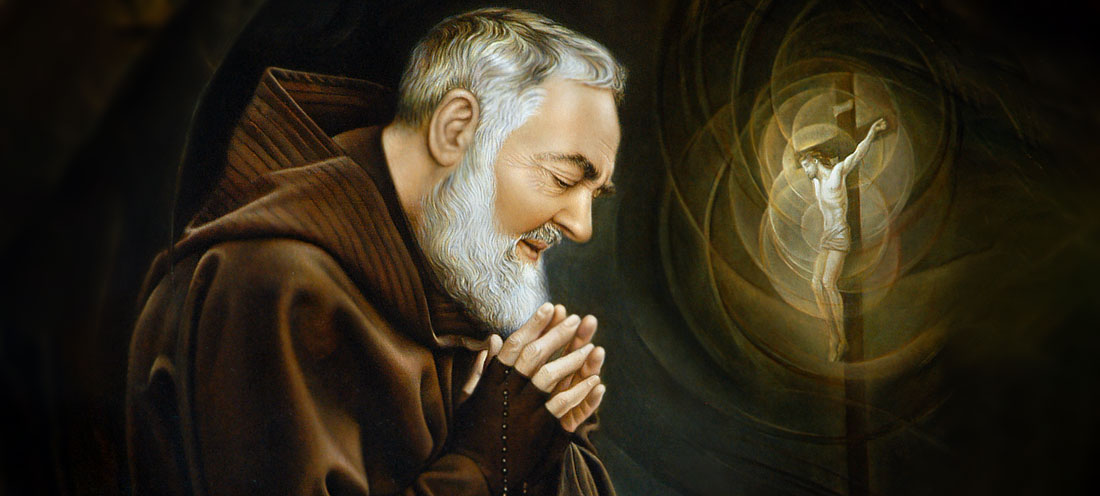
For fifty years, Padre Pio bore the visible wounds of Christ’s suffering and death on his body. All this time the stigmata remained intact, they were always fresh and bled, giving off a wonderful scent. By the time of his death they had completely disappeared, leaving no scars.
During the confession of his pupils on August 5, 1918, Padre Pio suddenly experienced a mystical vision. He saw an angel with a fiery spear who, as Padre Pio writes, “held in his hand something like a tool resembling a long, iron blade ending with a well-sharpened point that seemed to breathe fire. And he threw this hot tool with all his might at my soul. It was with great difficulty that I let out a moan. It seemed to me that I was going to die . . . I cannot describe my suffering . . . From that day on, I began to carry within me a fatal wound. I feel an open wound in the very depths of my soul, the source of my constant suffering.
On August 20, 1918, Padre Pio received visible stigmata. It was on Friday, at the hour when Christ was crucified. He describes this extraordinary event as follows: “I was sitting in the choir after celebrating Holy Mass when a strange state of rest, like a sweet dream, came over me. All my internal and external senses, as well as the capacities of my soul, were immersed in indescribable relief. While continuing in this state, I suddenly saw a mysterious figure next to me, similar to the one I had seen on August 5, except that it had blood on its hands, feet and side.
I experienced feelings that I will never be able to describe. I felt that I was dying, and I would have died if the Lord had not held my heart pounding in my chest. When the mysterious figure disappeared, I saw that my hands, feet and side were punctured, and blood was flowing from the wounds. Please imagine the suffering I experienced then and continue to experience every day.
The heart wound bleeds profusely, especially from Thursday evening until Saturday. I am afraid that I will die from loss of blood if the Lord does not listen to my groans and remove these wounds”.
Padre Pio could not hide the bleeding wounds even though he wrapped them with handkerchiefs. The superior demanded to see them. After the examination, he wrote to the general of the order that these were genuine wounds through and through. There is a tear in the side from which blood constantly flows.
The news about the stigmata quickly spread throughout Italy and the whole world. For two years, on the orders of the Provincial and the Capuchin General, Padre Pio’s stigmata were subjected to constant and meticulous medical examination. Studies have shown that these deep and bleeding wounds have a cause that science cannot explain. Not caused by mechanical trauma or chemical agents. The wounds had smooth edges, no infection, and were not healing at all.
In his report sent to the Holy Office, prof. Romanelli wrote that blood flowed from the wounds in such quantities that in a normal case there would be a risk of complete exsanguination. The wounds on the legs and arms are so deep that you can see right through them.
“It must be ruled out – the professor writes in his report – that the aetiology of Padre Pio’s wounds is of natural origin . . . from a scientific point of view, it is impossible to explain their formation . . . or even classify them, due to their nature and clinical course, as ordinary surgical wounds. They have a completely different origin and cause. Padre Pio is a living miracle.
Dr. Giorgio Festa, in his account, stated that “Padre Pio’s wounds and the haemorrhages that come from them have a source that our knowledge cannot explain . . . The blood that flows from cut veins in a living body does not have a pleasant smell. However, the blood that flows from Padre Pio’s wounds has a subtle and delicate smell. This phenomenon defies all natural and scientific laws, goes beyond logical explanation, and we honestly cannot do anything other than confirm the facts.”
For fifty years, until his death, Padre Pio’s wounds bled and remained fresh, never causing abscesses, necrosis or degenerative changes. All these facts remain an unsolvable puzzle for science, being in complete contradiction with the laws of nature. Moreover, at the moment of Padre Pio’s death, all the wounds mysteriously disappeared, leaving no scar. This was another great miracle.
Padre Pio felt extremely abased by having stigmata and that is why he wrote: “I will raise my voice to Him and I will not stop begging Him until He takes away from me – not torment or suffering, because I consider it impossible – but these external signs that cause chaos and cause humiliation impossible to describe and bear.”
The Saviour did not listen to this request because Padre Pio’s stigmata were to become a visible sign for all people of the extent to which God loved man. Christ made his wounds visible on the body of Padre Pio so that all people could see them and stimulate their hearts to greater faith and trust in His Mercy.
A Jesuit, talking to Father Pio, expressed surprise that despite receiving such great spiritual gifts, he did not lose humility. Padre Pio replied with a smile: “Imagine that someone asked you to transport a gold watch to be repaired in Milan. Wouldn’t you be a fool if you boasted to your friends that you owned it? Wouldn’t you be a thief if you kept it for yourself?”
Padre Pio said of himself that he “bears this cross for everyone.” His wounds caused him constant pain.
“When I allow myself to sleep a little,” he said, pointing to the wounds in his hands, “their pain increases unbearably.”
Jesus Christ in the stigmata of Padre Pio showed us the wounds of His passion and death on the cross to remind us of the truth about His infinite love. It was He, the God-Man, who “burdened Himself with our suffering, bore our weaknesses . . . He was pierced for our sins, crushed for our iniquities” (cf. Is 53:4-5).
It is God himself, in the humanity of Jesus, who takes upon Himself the sins of all of us and experiences how terrible sin is in order to destroy it, defeat Satan and give all people a chance for salvation. From the moment of Christ’s passion, death and resurrection, every human suffering, experienced in unity with Christ, becomes a path of salvation, a participation in the suffering through which Christ redeemed the world.
Padre Pio participated in the saving suffering of the Saviour in a unique way. He experienced all the stages of Jesus’ suffering and agony on his own body. He experienced this especially during every Holy Mass, which is the embodiment of the mystery of Christ’s passion, death and resurrection. During daily Holy Mass, Padre Pio experienced deep union with the crucified Jesus, suffering from human sins of unbelief and ingratitude. He confided that during the celebration of the Eucharist he suffered “from beginning to end in an increasing way. Mostly from consecration to communion”.
Padre Pio suffered with Christ, united with Him in a love capable of the greatest self-sacrifice, but a love despised and rejected by many people. Padre Pio wrote down the words of Jesus’ complaint that he heard during one of his visions: “With what ingratitude people respond to My love! I would be less offended by them if I loved less. My Father cannot bear them any longer. Lazy people do not make any effort to overcome temptations, what is more, they take pleasure in their sins. My most beloved souls, when they are tested, follow Me less and less zealously; the weakest of them succumb to fear and hopelessness, and the hottest ones gradually cool down. My Heart has been forgotten, who cares about My love? For many people, my churches have become entertainment theatres. Even from those who worked with Me, whom I had special love for and guarded like the apple of My eye; even from those who should share the bitterness of My Heart and help in the redemption of souls, I experience – who would believe it?! – ingratitude and forgetfulness. I look, my son, at many of them (here Jesus wept) who with hideous hypocrisy betray Me with sacrilegious communions, depriving them of the graces and inspirations that I constantly give them”.
Padre Pio united his sufferings with those of Christ for the most hardened sinners.
He wrote: “How much it breaks my heart to see poor sinners . . . these unfortunate people have lost even the ability to consider what punishment awaits them in eternity. Jesus continues to call them to Himself, but they pretend not to hear anything; they run away from Him, not realizing that it is to their own destruction. What is the way for these [dead] to come back to life?”
There is only one way: to love them with the same love that Jesus loves them, that is, to take upon yourself the suffering caused by their sins, to experience for yourself the harm they have done to God through indifference, rejection and hostility towards His love. And in this experience of suffering, make amends and make reparation to God for the terrible harm and pain of the rejection of His love. Throughout his priestly life, Padre Pio constantly offered himself and his sufferings to God for the salvation of sinners. On the day of his priestly ordination, he decided that “he would be a holy priest and a perfect sacrifice.”
He wrote to his spiritual director in 1910: “For a long time I have felt the need to consecrate myself to the Lord as a sacrifice for poor sinners and the souls in purgatory. This desire continued to grow in my heart, so that now it became, I might say, a strong passion. I have made this offer to the Lord many times, asking Him to send me other punishments prepared for sinners and souls in purgatory, even increasing them a hundredfold for me, if only He would convert and save sinners and quickly admit the souls in purgatory to heaven”.
Appearing to Padre Pio (in 1913), the Lord Jesus asked: “My son, I need sacrifices to eliminate the just and divine anger of my Father; renew your total consecration to Me and do it without any reservations.”
Throughout his life, Padre Pio repeated the act of sacrificing himself to God several times a day. By uniting himself in suffering with Christ, Padre Pio transformed his suffering into glory and joyful thanksgiving to God.
He wrote: “I enjoy suffering more than ever, and if I only listened to the voice of my heart, I would ask Jesus to give me all the worries of people; but I won’t because I’m afraid of being too selfish by wanting the best part for myself: the pain. He comes begging for suffering, tears . . . . He needs them for souls . . . I became worthy to suffer with Jesus and like Jesus. Yes, I love the cross, only the cross; I love it because I always see it on Jesus’ shoulders. Now Jesus sees clearly that my whole life, my whole heart is devoted to Him and His sufferings. I am crucified for love.”
On the day of his priestly ordination, Padre Pio sang a wonderful song of love that sums up his entire earthly life: “Jesus, my breath and my life, today, as I tremblingly lift You up in the mystery of love, together with You I will be the Way, the Truth and the Life for the world, and for You a holy priest, a perfect sacrifice” (August 10, 1910).
Sharing his own experience, he wrote: “We cannot even understand how great a relief we bring to Jesus when, out of love for Him, we do not demand any consolation in order to participate in His suffering . . . The most beautiful act of faith flows from our hearts during the night of sacrifices and suffering and greatest efforts to do good; like lightning, it tears apart the darkness of your soul and carries you away through the storm to the heart of God . . . If love does not nourish and strengthen itself with the Cross, it is only a straw enthusiasm, not true love.”