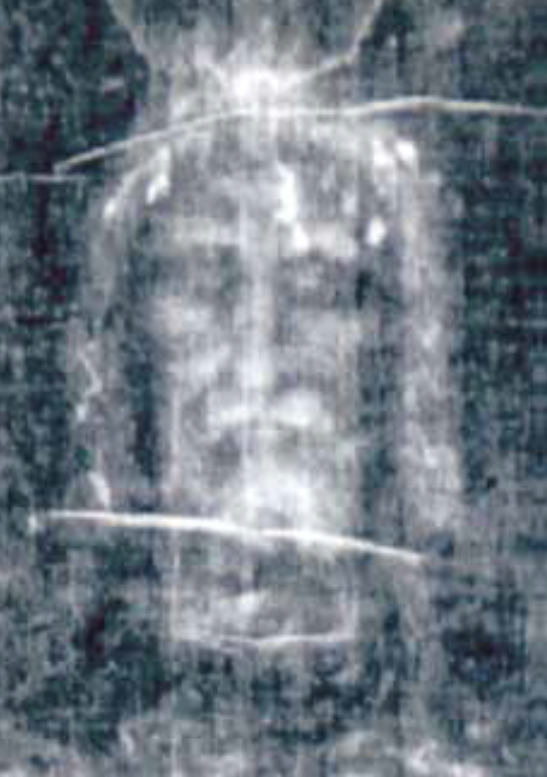
Jesus left us a shocking view of suffering and death upon the image of His mutilated body, which lies imprinted on the winding sheet that wrapped it after it was taken down from the cross and laid in the tomb. Since no traces of decay are detectable on the Shroud forensic experts conclude that the body remained in the burial cloth for about thirty-six hours.
The Shroud of Turin is a telling witness of the inconceivable sufferings borne by Jesus during His Passion and Death on the cross. It tells us how the true God who became true man suffered in order to save us — to free us from bondage to sin and death. All are responsible for the suffering and death of the Saviour. Every sin that has ever committed and will be committed inflicts yet another wound on the body of Jesus and brings about His death on the cross. The magnitude of suffering born by the Son of God becomes the source of our salvation. When we offer our own suffering up to Jesus, His Passion becomes the way of our salvation, a fountain of grace. Rather than destroy us, it sanctifies us and works for the salvation of others. The image of the tormented Jesus on the Shroud reveals the extent of God’s love for every human being. Truly, He loved us “to the end” (Jn 13:1).
The Shroud reveals to our eyes the body of Jesus in a state of rigor mortis. His bearded chin reposes on His breast so that we don’t see His neck. Having undergone the appalling torments of scourging, the imposition of a crown of thorns, and crucifixion, His body bears the marks of almost 600 wounds and lesions. Jesus begs us to probe the depths of His love by contemplating His Passion: “… meditate frequently on the suffering I have undergone for your sake…. You please me most when you meditate on my Sorrowful Passion” (Diary, 1512).
The face of Jesus
The face of the Crucified Man of the Shroud is striking in its serene beauty and depth of Divine mystery — this despite the abrasions to the eyelids and eyebrows, the swelling over the right zygoma, the broken septum inflicted by a rod, and the blood-clotted hair. The brow reveals a large clot shaped like the number 3. The moustache and beard are caked with blood, and there are scalp lesions from hair being torn out by the roots. As we read in the Gospels: “And they struck his head with a reed, and spat upon him and they knelt down in homage to him” (Mk 15:19); and “they struck him with their hands” (Jn 19:3). This is how blasphemers were treated in Jesus’ time; for it was for blasphemy that Jesus was condemned to death — for considering Himself God. Yet despite all these physical and spiritual sufferings, Jesus radiates a Divine sense of peace, thus attesting to the fact that He was God, and that He bore such monumental suffering with the knowledge of the final victory. No longer would suffering and death be bereft of meaning.
The crowning with thorns
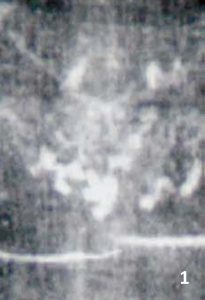
Soldiers “plaited a crown of thorns and laid it on his head” (Jn 19:2). This method of torture was designed uniquely for Jesus. No other historical source mentions such a torture preceding crucifixion. The Shroud shows numerous bloodstains on the skull which appear in the form of a positive print. These were caused by the thorns puncturing the blood vessels of the head. The crown of thorns was shaped like a bonnet, which wrapped the entire upper portion of the head. Surgeons have located thirteen thorn wounds on the forehead and twenty at the back of the head, but there could have been as many as fifty wounds altogether. Since the upper head embraces a whole network of nerves and blood vessels, the crown of thorns must have caused enormous pain and bleeding. “If one considers — states L. Coppini, Director of the Institute of Anatomy at Bologna University — that there are over 140 pain-sensitive areas per one square centimetre of scalp tissue, one can imagine how unbearable must have been His pain.” Studies show that the blood traces correspond to the anatomy of the blood vessels on the head. Here is yet another piece of evidence attesting to the authenticity of the Shroud, for the human circulatory system was not understood or described until 1593.
The scourging
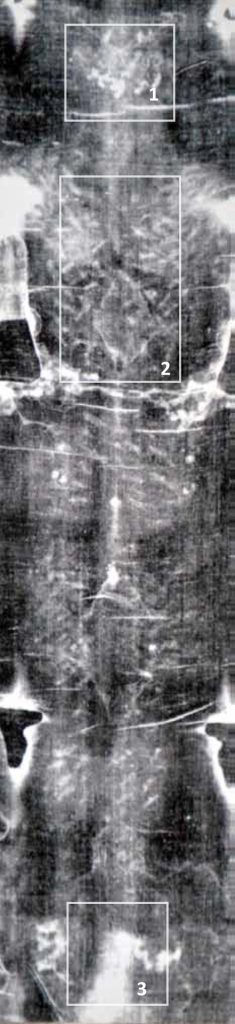
Jesus underwent brutal scourging. The entire body bears traces of wounds caused by a type of Roman whip called the flagrum. The wounds to the buttocks show that Jesus was beaten naked. Scourging was a terrible punishment, which often resulted in death. Scourging was ordinarily reserved only for those who were spared the death penalty. Those so punished would be set free afterwards. The whip consisted of three longish thongs tipped with metal fragments. On striking the body, these tore out whole lumps of flesh. Initially, Pilate desired Jesus to be scourged only. He says, “I will therefore chastise him and release him” (Lk 23:16).
This explains the great number of lashes and the unusual brutality with which the soldiers administered them. They understood this to be the only punishment to be meted out. There were two soldiers. The one on the right was taller and more sadistic in the discharge of his duty. Jesus stood slightly bent with His hands tied to a pole. The thongs of the whip wrapped around His body, lashing the front parts, the chest, abdomen, shins, and thighs.
The Way of the Cross
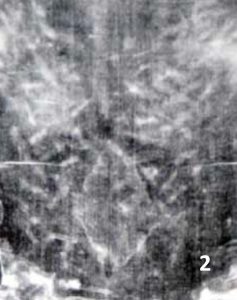
From the left and right shoulder wounds shown on the Shroud, some experts conclude that Jesus carried the horizontal beam of the cross, called the patibulum, and that His arms were tied to it. The beam probably weighed about thirty kilograms and was 1.8 m. long. Other experts believe Jesus carried the whole cross. Utterly exhausted by the scourging, Jesus walked to the place of execution with extreme difficulty. He had to cover a distance of about half a kilometre. He fell several times on His face, His knees landing heavily on the rocky road. Experts have noted large abrasions to the face, nose (particles of soil and stone mixed with blood), and knees, especially the right one. Since Jesus was unable to carry the cross by Himself, the centurion forced Simon of Cyrene to carry it behind Him (Lk 23:36).
Crucifixion
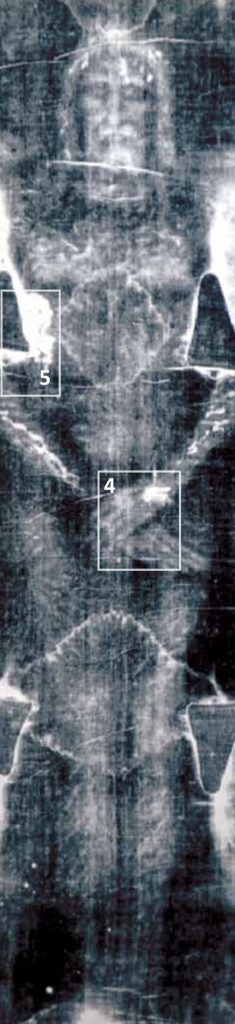
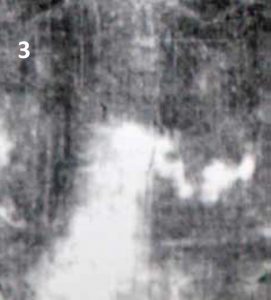
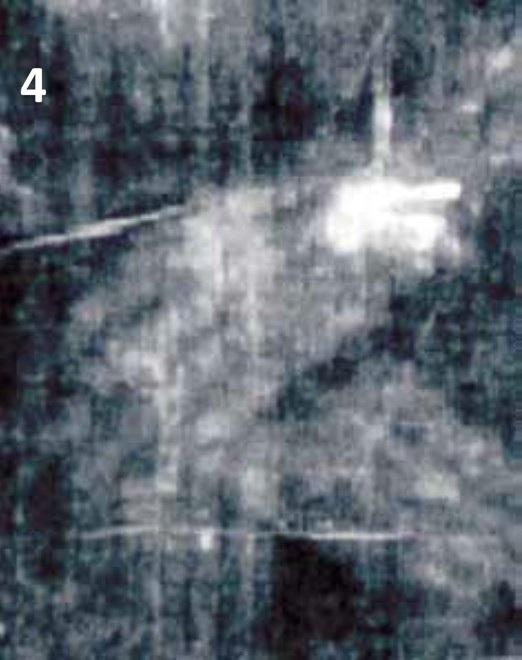
Death by crucifixion was one of most brutal and degrading forms of torture practiced in the time of Christ. The Shroud clearly shows the nail wounds to the wrists. As to the feet, these were pinned to the vertical beam of the cross by a single nail. The spike pierced the tarsal bone. The left foot was placed over the right. The hands, resting crosswise over the abdomen, are clearly visible. Over the left wrist there is a large blood clot in the shape of the letter U. The hands were nailed to the beam at the wrist, since the weight of the body was too great to be supported by the palms. Hands pierced at the palm and weighed down by the body would eventually tear free. The nails were driven through “Destot point” located between the bones of the wrist. Although the spot is free of major blood vessels, it is the site of the median nerve, which controls the movements of the thumb. The piercing of the wrist and median nerve at the Destot point caused the thumb to be bent inward so that only four fingers are visible on the Shroud.
The Shroud indicates two rivulets of blood flowing down the arm from the wound of the left wrist. Experts have thus been able to reconstruct the position of Jesus’ arms on the cross. While hanging on the cross, Jesus would have tried periodically to raise Himself by His legs in order to breathe. Extreme pain and exhaustion forced Him to lower himself again.
This successive lifting and lowering of his body on pierced hands and feet continued for three hours and caused indescribable suffering. The process would have repeated itself ever more frequently, until finally utter exhaustion and death won the day.
The rupture of the heart
The wound in Jesus’ right side was one-and-a-half centimetres wide and four and-a-half centimetres long. Analysis of this wound and the considerable discharge of blood and fluid into the pleural cavity indicates that the cause of death was rupture of the heart due to cardiac arrest. This would have precipitated a massive haemorrhaging into the pericardium (about two litres of blood) and thence into the lungs, causing hemopericardia. A sudden rupture of the pericardium due to a high build-up of blood would have resulted in a paralyzing pain in the sternum area. It would have caused Jesus to cry out instantly, and then die. “Jesus cried out again in a loud voice, and gave up his spirit” (Mat 27:50). A violent death occurring in a state of full consciousness normally precipitates a stiffening of the body (rigor mortis). This would explain why the body imprinted on the Shroud appears to be so rigid.
Shortly after Jesus’ death, the blood in the pericardium would have separated into red corpuscles (accumulating in the lower part of the pleural cavity) and blood plasma (remaining in the upper part). When his breast was pierced by the centurion’s lance, both fluids flowed out, first the red corpuscles, then the blood plasma, that is, “blood and water” as described in St. John’s Gospel.
The pierced heart of the Saviour stands as a sign of God’s immense love of us. In becoming true man, Jesus chose to “empty himself of all things” and accept a truly human death, along with the burden of our sins. Though innocent, and knowing no sin, the God-Man experienced in the moment of his agony and death the full extent of the suffering caused by sin. “Yet it was our infirmities that he bore, our sufferings that he endured, while we thought of him as stricken, as one smitten by God and afflicted. But he was pierced for our offenses, crushed for our sins. Upon him was the chastisement that makes us whole, by his stripes we were healed”(Is 53:4-5).
In this terrible experience of suffering and death for the sins of humanity, Jesus acted in perfect obedience to His Father. He became “obedient to death, even death on a cross” (Phil. 2:8). His suffering reached its climax at the moment of his agony on the cross, when he cried out, “My God, My God, why have you forsaken me?” (Mat 27:46). Here is the central event of the history of the created world. It is at this point that His suffering reaches to the limits of sin’s destructive power, overcoming it with inexhaustible filial love and obedience to the Father’s will. Through His Death and Resurrection, Jesus won the final victory over death and sin. He offers all of humanity a share in this victory. In order to experience the miracle of the forgiveness of sins, we need to be willing to entrust and open our hearts to the boundless Mercy of God. We need to approach the confessional grill and make an honest admission of our sins. Through the image of His mutilated body on the Shroud, Jesus urges us to seek absolution from every sin in the sacrament of penance and so remain in a state of sanctifying grace. Thanks to Our Lord there is no hopeless situation in life. If we fall into sin, Jesus stands ready to raise us up and set us free. We have only to entrust ourselves to Christ with total confidence. “O my Jesus, how very easy it is to become holy; all that is needed is the tiniest amount of good will. If Jesus sees this, He hurries to give Himself to the soul, and if the soul is faithful to this grace from God she can very soon attain the highest holiness for a creature here on earth. God is very generous and does not deny His grace to anyone; indeed, He gives more than what we ask of Him” (Diary, 291)
23/04/2023