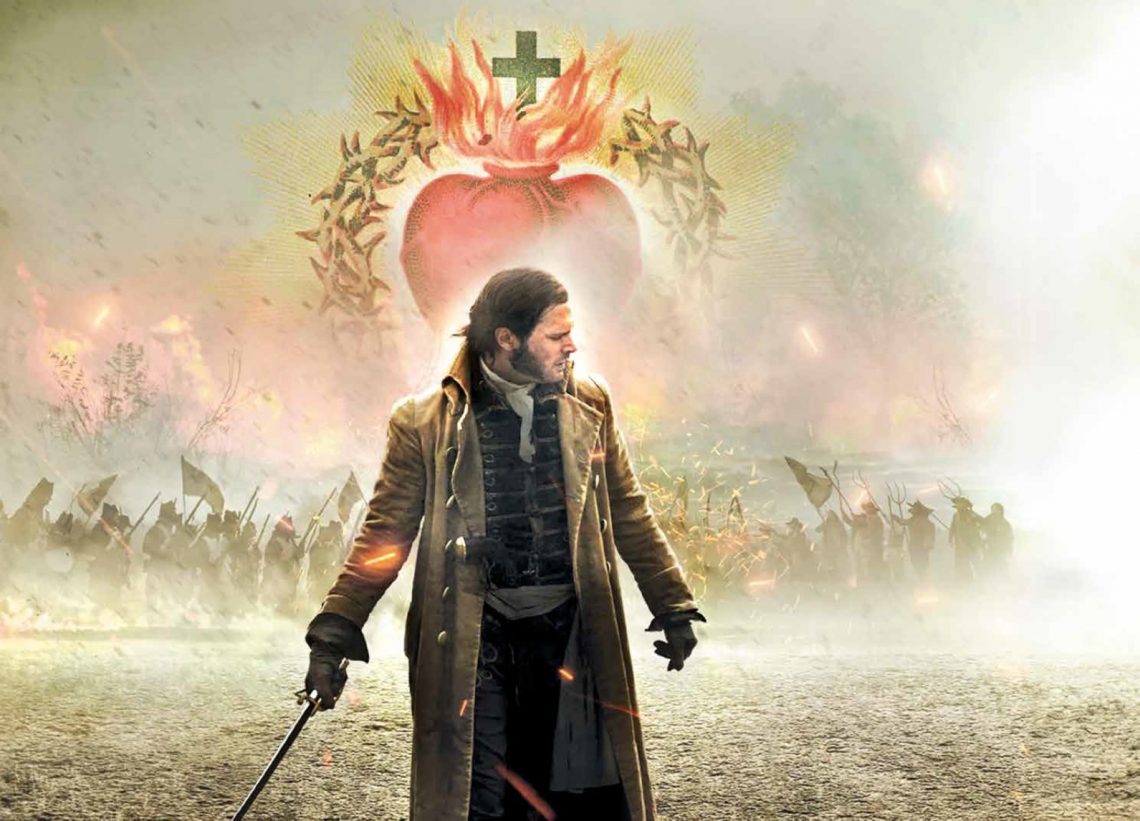
Vendée rebels adorned their banners with the images of the Sacred Heart of Jesus (Sacré Coeur). When they marched, they recited the rosary. They regularly attended the Holy Mass, banned by the revolutionary regime, which were celebrated by “illegal” (“unsworn”) priests.
People Do Not Want an Anti-Christian Revolution
Historical records from the French Revolution, including the proceedings of revolutionary tribunals, indicate that when the anti-Christian terror reached its height in 1793–1794, the vast majority of those executed by guillotine came from the Third Estate. In other words, most of the victims were peasants and townspeople – the very groups in whose name the revolution had supposedly been launched in 1789.
This anti‑peasant dimension of the radical revolutionary regime was revealed most starkly in the Vendée. In the spring of 1793, the people of this western province took up arms against the Republic, forming what they called the Catholic and Royal Army to resist those who claimed they would “start the world anew.” The name of their army points to the deepest motives of these rural insurgents. They rose when the revolutionaries intensified their campaign of de‑Christianisation: the suppression of public worship across France, the closing of churches, and the persecution of Catholic clergy. These measures coincided with the execution of King Louis XVI on 21 January 1793 and with mass conscription ordered in March of the same year.
For the people of the Vendée, the death of the King signalled that a regime had taken hold in Paris that trampled upon France’s centuries‑old religious and political traditions; after all, the King was an anointed sovereign. The conscription decrees were also seen as an illegitimate imposition, unthinkable under the ancien régime, which had relied primarily on a professional army. The peasants of the Vendée refused to shed their blood for a government they believed to be hostile to the Catholic faith and to the historic identity of France.
Under the Banners of Sacré Coeur
In the spring of 1793 a popular uprising broke out across the Vendée. From the outset it was a peasant revolt. Paradoxically, in this corner of revolutionary France the prized watchwords of ‘liberty, equality, fraternity’ found a certain expression within the royalist ranks: the leaders of the insurgent forces were elected in open, general assemblies. Even Napoleon later conceded, ‘In the Vendée army this great principle [of equality] prevailed.’
Some nobles felt the weight of local expectation – at times pressure – to take command of parish and district companies in the Catholic and Royal Army. The legendary commander François de Charette was, according to tradition, literally dragged from beneath a bed to assume leadership. Others, such as Marquis Charles de Bonchamps and Count Henri de La Rochejaquelein, also joined – if not always entirely of their own initial choosing – soon proving themselves outstanding commanders.
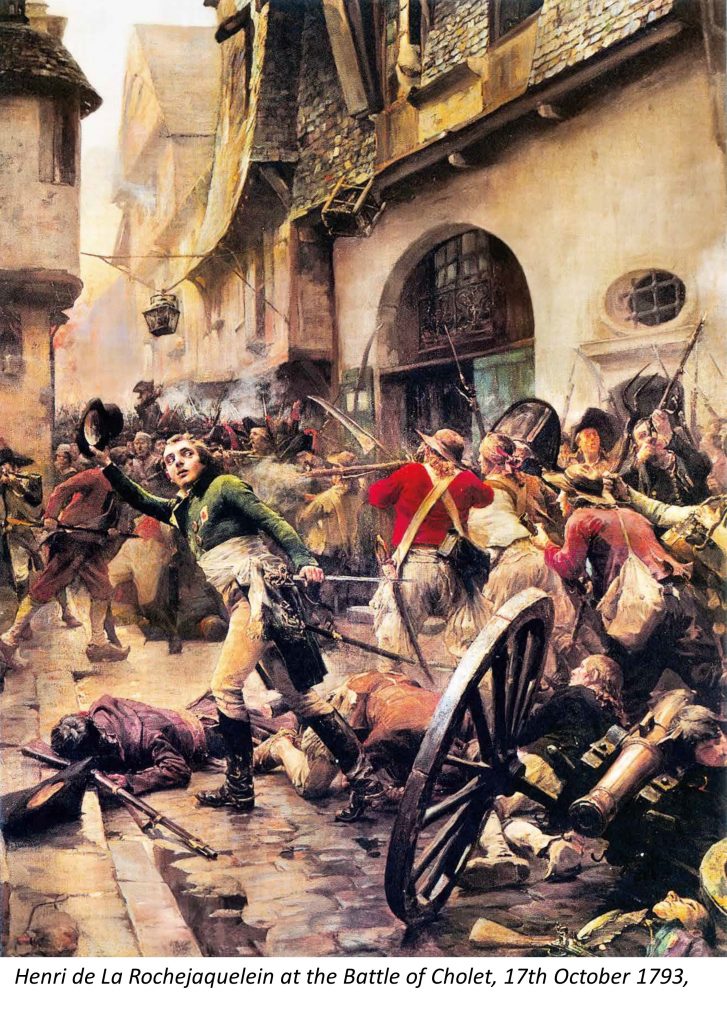
One peasant from Le Loroux-Bottereau described the men and their manner of fighting: ‘Our army was made up of peasants like me, wearing simple loose smocks or coarse coats, carrying shotguns, pistols, muskets and, quite often, ordinary tools – scythes, sticks, axes, knives used at the wine-press, or spits for roasting. We organised ourselves by parishes and districts under a chosen captain, and then marched straight at the enemy, kneeling first for our priests’ blessing. We began with a continuous fire – certainly chaotic, but dense and well aimed. The orders our officers gave were only things like, “Form up, lads, here come the Blues [the Republican forces]!” At that we spread out, fanning wide to envelop the enemy.’
The Vendeans fought on home ground, an early advantage magnified by surprise. The landscape itself mattered. In 1793 the Vendée was thickly wooded, a place of ambush and confusion for outsiders. General Jean-Baptiste Kléber, commanding Republican troops there, wrote that the region was ‘a deep, dark maze where one gropes one’s way; in this real system of natural barriers and caltrops you must search for winding roads.’
Yet, as the modern historian Reynald Secher has argued, the decisive factor was not terrain or organisation but morale – rooted in a living faith. The insurgents carried banners marked with the Sacred Heart of Jesus, prayed the rosary on the march, and sought out Holy Mass, proscribed by the revolutionary authorities, celebrated by non‑juring (unsworn) priests.
Even some of their most implacable adversaries recognised their courage. General Louis‑Marie Turreau, commander of the ‘infernal columns’ that devastated the region, called the Vendeans ‘truly extraordinary people’ and ‘a formidable enemy who must be placed in history among the first rank of courageous peoples’. Napoleon himself would later describe them as ‘a people of giants’.
Whatever one’s assessment of the politics of the time, it is hard to overlook the simple fidelity of these men and women. Their standards bore the Sacred Heart; their strength sprang from the sacraments and prayer; and their struggle – tragic and intense – remains a striking witness to the power of faith to form conscience, community, and courage.
Victories and Defeats
By mid-June 1793 the Catholic and Royal Army had brought almost the whole Vendée under its control. The capture of Angers on 18 June marked the high point of its campaign. Then came the turning point of the war: the failed assault on Nantes. Its capture might have enabled a junction with sympathetic forces in Brittany, where opposition to the new revolutionary order was also significant. During the attack on 29 June the commander-in-chief, Jean Cathelineau, was mortally wounded. The subsequent deaths of other charismatic Vendéan commanders, including Bonchamps and d’Elbée, further weakened the insurgency. Without undisputed leaders, the movement struggled to maintain a coherent, unified command, and coordination between local forces deteriorated.
Meanwhile, the Republic steadily reinforced the Vendée front. In the spring and summer of 1793 it had been hard-pressed on the Rhine by the forces of the anti-French coalition; but with the eastern frontier stabilising in September, the authorities transferred the 20,000-strong Army of Mainz under General Kléber to the Vendée. From the autumn of 1793 the Republicans enjoyed clear numerical superiority and far greater resources in men and materiel. This imbalance could not be redressed by the sporadic and irregular British assistance available to the insurgents.
Even so, on 19 September at Torfou the Vendéan forces defeated a Republican army. It proved to be their last major success. A month later they were beaten at Cholet. On 14 November their attempt to take Granville ended in further failure. The final defeat came at Savenay on 23 December. Afterwards General François-Joseph Westermann reportedly wrote to the National Convention: “Citizens of the Republic, there is no Vendée any more; it has fallen under the blows of our free sabre, together with its women and children. I have just buried them in the mud and woods at Savenay. Carrying out the orders I had received from you, I crushed the children under the hooves of our horses and killed the women if only to stop them from bearing more bandits … Roads are strewn with corpses everywhere. There are so many of them that in some places you can pile them in pyramids … We take no prisoners because we would have to feed them and mercy is not a revolutionary virtue.”
French-French Genocide
In the final and most brutal phase of the War in the Vendée, some Republican commanders spoke in terms of total destruction. Debates in the National Convention in mid-1793 considered drastic measures to crush the revolt; on August 1 directives ordered the devastation of the region’s resources, and subsequent orders urged soldiers to eliminate “Vendée bandits” by the end of October. Some historians see the repression that followed as bearing genocidal intent, though the terminology is debated.
Official language at times dehumanized opponents. Women were labelled “reproductive soil,” and children “future rebels.” General Louis Marie Turreau, commanding the Army of the West, wrote that “the Vendée must become a national cemetery.”
Ideas aired in revolutionary bodies even included poisoning wells or employing chemical agents to kill swiftly – proposals that reveal the extremity of the moment, whether or not they were carried out.
Commissioner Jean-Baptiste Carrier urged mercilessness and oversaw mass drownings in the Loire (noyades). In early 1794, the “infernal columns” moved into the countryside; in his order of January 17, Turreau directed his troops to burn what could be burned and kill those they met, conceding that innocents might be sacrificed.
As Catholics, we mourn the victims, commend them to God’s mercy, and pray for a public life that defends the dignity of every human person.
What Can Be Learned from the Vendée Uprising?
The final toll was appalling. According to the historian Reynald Secher, of an estimated 815,000 inhabitants in January 1793, some 117,000 perished in what he characterises as a methodical extermination. Of 53,000 houses, more than 10,000 were destroyed. The authorities even sought to erase the region symbolically: on 7 November 1793 the Convention voted to rename the department from ‘Vendée’ to ‘Vengé’ (‘avenged’).
The sufferings of the Vendéan peasantry foreshadowed later tragedies in which ideological regimes turned against rural populations – from the Volga and Ukraine to China and Cambodia. While historians debate specific analogies and numbers, the warning remains clear: when a state tries to remake society by force, it is tempted to treat persons not as neighbours to be served but as obstacles to be removed.
Some commentators have noted that late nineteenth‑century Ottoman officers studied European counter‑insurgency, including the campaign in the Vendée. Whatever the influences, the mass deportations and killings of Armenians during the First World War stand as one of the first genocides of the twentieth century.
For the Church, the deepest lesson is spiritual as well as historical. Saint John Paul II, who consistently broadened the martyrology of the universal Church, raised to the altars many victims of Revolutionary violence from regions scarred by the Vendée conflict, formally recognising them as martyrs for the faith. Their witness reminds us that religious liberty, worship, and conscience are not concessions of the state but fundamental goods rooted in the dignity of the human person.
What, then, can we learn?
- The sanctity of every human life, even – and especially – in times of upheaval.
- The danger of dehumanising language and ideological zeal that excuses cruelty.
- The duty to defend religious freedom and the rights of local communities.
- The importance of subsidiarity and the common good over coercive social engineering.
- The need for a purified memory: truth without rancour, justice without vengeance.
- A Christian response of prayer, repentance, and reconciliation, while steadfastly resisting any ideology that makes war on the image of God in the human person.
As Catholics, we remember the Vendée with sobriety and compassion. We honour the martyrs, mourn all the victims, and commit ourselves to building a society where truth, charity, and the dignity of every person are upheld.
Henri de La Rochejaquelein at the Battle of Cholet, 17th October 1793, Paul Emile Boutigny
11/09/2025